



Insights
Best practices and tips on spend management, automated expense tracking and corporate debit cards for Australian SMB and enterprise businesses.
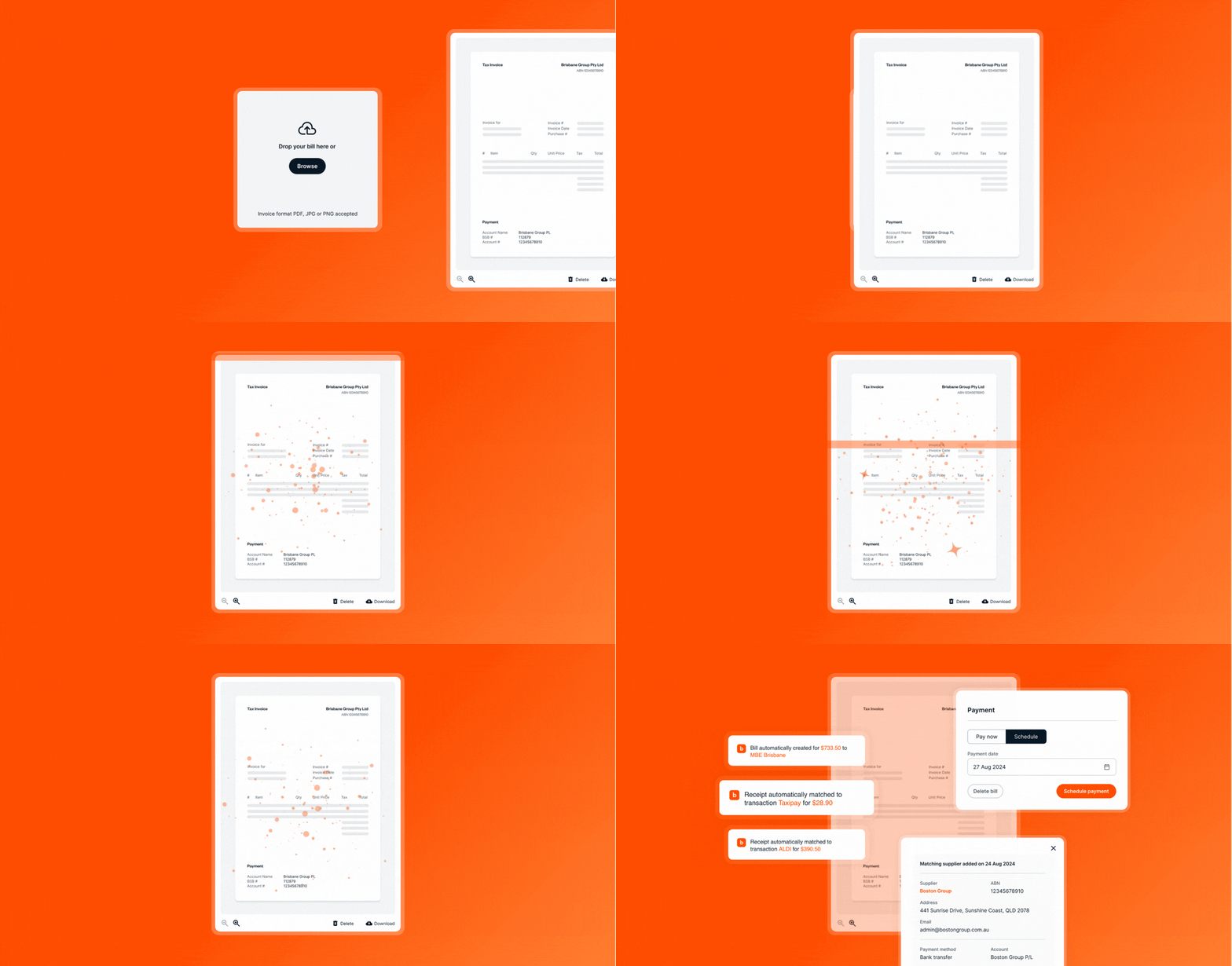
Managing accounts payable manually is becoming a serious bottleneck for Australian small and medium businesses. As invoice volumes grow and supplier relationships become more complex, the traditional approach of paper-based processing, email approvals and spreadsheet tracking simply can't keep up.
Manual AP processes don't just waste time. They create cash flow blind spots, delay supplier payments, damage vendor relationships and increase the risk of duplicate payments or fraud. When you're only discovering problems during month-end reconciliation, you've already lost control of your financial position.
The solution isn't necessarily hiring more staff or accepting inefficiency as the cost of doing business. Smart Australian SMEs are either outsourcing their accounts payable function to specialist providers or implementing automated systems that handle the entire process digitally. Both approaches can transform your AP operations, but they work very differently and suit different business needs.
This comprehensive guide explains what accounts payable outsourcing really means for Australian businesses, how it compares to automation alternatives, and how to choose the right approach for your specific situation.
Here's everything you need to know in under a minute:
- Accounts payable outsourcing involves hiring external providers to manage invoice processing, approvals and payments
- It can reduce costs and free up internal resources but limits control and visibility
- AP automation keeps processes in-house while eliminating manual work through software
- Australian SMEs often benefit more from automation due to better integration with local banking and accounting systems
- The choice depends on your need for control, data security requirements and long-term growth plans
- Modern platforms like Budgetly combine the efficiency of automation with the simplicity SMEs need
Table of contents:
- What is accounts payable outsourcing
- Why Australian businesses consider AP outsourcing
- How accounts payable outsourcing works
- Benefits of outsourcing accounts payable
- Drawbacks of AP outsourcing
- Accounts payable outsourcing vs automation
- When outsourcing makes sense for Australian SMEs
- How to choose the right AP outsourcing provider
- How much does accounts payable outsourcing cost?
- The Budgetly advantage with automated AP solutions
- Implementation best practices
- Common mistakes to avoid
- Frequently asked questions
- Taking control of your financial future
What is accounts payable outsourcing?
Accounts payable outsourcing is the process of hiring an external company to manage some or all of your invoice processing, supplier payments and related administrative tasks. Instead of handling these functions internally, you partner with specialists who take responsibility for capturing invoices, validating data, managing approvals and executing payments on your behalf.
The scope can vary significantly depending on your business needs. Some companies outsource only data entry and invoice processing, while others hand over complete responsibility for vendor management, payment scheduling and reconciliation reporting.
A typical outsourced AP arrangement includes invoice capture from multiple channels, data validation and entry into your accounting system, purchase order matching, approval workflow management, payment processing via various methods, and regular reporting on AP performance and outstanding obligations.
For Australian businesses, this can mean partnering with local providers who understand GST requirements, Australian banking systems and local compliance obligations. International providers may offer cost advantages but might not fully understand Australian-specific requirements.
Why Australian businesses consider AP outsourcing
Australian SMEs face unique pressures that make AP outsourcing attractive. Understanding these drivers helps determine whether outsourcing aligns with your specific business challenges.
Lack of visibility into cash flow
Manual accounts payable processes make it nearly impossible to get real-time visibility into committed spending and upcoming payment obligations. When invoice processing is paper-based and approvals happen via email, business owners can't accurately predict cash flow requirements or identify spending patterns until it's too late.
Poor supplier relationship management
Suppliers want to be paid on time so they can manage their own cash flows. Late payments, lost invoices and poor communication strain these important business relationships. If your AP function isn't organised, suppliers may experience long delays getting payment status updates or resolving billing queries.
Many businesses turn to corporate card solutions and virtual card systems to improve supplier payments while maintaining better control over spending.
Expensive manual processing costs
Manual invoice processing is surprisingly expensive when you factor in staff time, error correction and late payment penalties. Industry research suggests businesses pay around $15-25 to process each paper invoice when including all associated labour costs. For companies handling hundreds of invoices monthly, this represents significant expense.
An effective expense management system can dramatically reduce these processing costs while improving accuracy and control.
Compliance and audit requirements
Australian businesses must maintain proper records for GST reporting, tax audits and regulatory compliance. Manual systems often lack the documentation and audit trails required, creating stress during reviews or investigations.
Resource constraints during growth
Fast-growing businesses often find their AP workload increases faster than they can hire qualified staff. Outsourcing provides immediate access to additional processing capacity without the overhead of recruitment, training and ongoing employment costs.
Modern budget management software can address many of these challenges while keeping control internal to your business.
How accounts payable outsourcing works
Understanding the typical AP outsourcing process helps you evaluate whether it fits your business operations and management style.
1. Initial assessment and setup
The provider analyses your current AP processes, invoice volumes and specific requirements. They'll review your accounting systems, approval hierarchies and compliance needs to design appropriate workflows.
During onboarding, they establish secure connections to your accounting software and set up data transfer protocols. Your vendor master file, approval rules and payment methods are configured in their systems.
2. Invoice capture and processing
Suppliers can send invoices directly to the provider via email, portal uploads or electronic integration. The provider captures invoice data using optical character recognition technology and validates it against purchase orders and vendor records.
For businesses using bill payments systems, this integration can be seamless with existing payment workflows.
3. Approval management
Invoices are routed through your established approval hierarchies using the provider's workflow systems. Approvers typically receive notifications via email or portal access, with the ability to approve, reject or request additional information.
4. Payment processing
Once approved, the provider schedules payments according to your cash flow preferences and supplier terms. They can handle various payment methods including electronic transfers, cheques and international payments.
5. Reconciliation and reporting
Regular reports provide visibility into processed invoices, pending approvals, payment schedules and key performance metrics. Month-end reconciliation packages support your internal accounting and compliance requirements.
An expense tracker can complement these outsourced processes by providing additional visibility into business spending patterns.
Benefits of outsourcing accounts payable
When implemented properly, AP outsourcing can deliver significant operational and financial benefits for Australian SMEs.
| Benefit | Description | Typical Impact |
|---|---|---|
| Reduced processing costs | Outsourcing providers achieve economies of scale through specialised staff and optimised processes | 20-40% reduction in per-invoice processing costs |
| Access to expertise | Professional AP teams with specialised knowledge and technology | Access to enterprise-level capabilities without investment |
| Improved payment timing | Dedicated teams focus solely on processing and payment schedules | Better supplier relationships and early payment discounts |
| Scalability | Capacity adjusts to match business needs without hiring complexities | Handle seasonal peaks or growth without staffing changes |
| Better compliance | Standardised processes and detailed audit trails | Meet Australian regulatory requirements more effectively |
| Enhanced fraud prevention | Sophisticated detection systems and separation of duties | Reduced risk of unauthorised payments or duplicate processing |
For additional guidance on implementing these benefits, consider reviewing our comprehensive AP automation guide for Australian businesses.
Drawbacks of AP outsourcing
Despite the potential benefits, AP outsourcing introduces challenges that Australian business owners should carefully consider.
1. Reduced control and visibility
When outsourcing AP functions, you depend on external reports and dashboards for visibility into your payment obligations and processing status. Real-time access to information may be limited, making it harder to respond quickly to urgent supplier enquiries or cash flow changes.
2. Data security and privacy concerns
Sharing sensitive financial information with external providers creates additional security risks. While reputable providers maintain strong security measures, data breaches at third-party companies can still expose your financial information.
3. Communication delays
Questions about specific invoices or payment status may require communication through the provider's systems rather than direct access to information. Time zone differences or service level limitations can create delays in resolving issues.
4. Limited customisation
Outsourcing providers typically operate using standardised processes that may not perfectly match your business requirements. Custom workflows or unique approval hierarchies might not be supported or could incur additional costs.
5. Vendor relationship challenges
When suppliers have payment queries or disputes, they may need to communicate through the outsourcing provider rather than directly with your team. This can slow resolution times and potentially impact important business relationships.
6. Hidden costs and fee escalation
While base pricing may appear competitive, additional services like rush processing, custom reporting or scope changes often incur extra charges. These costs can accumulate quickly and impact the overall value proposition.
A comprehensive accounts payable software guide can help you understand alternatives that avoid many of these limitations.
Accounts payable outsourcing vs automation
The choice between outsourcing and automation represents two fundamentally different approaches to solving AP challenges. Understanding these differences is crucial for making the right decision for your business.
| Factor | AP Outsourcing | AP Automation |
|---|---|---|
| Control and ownership | External provider manages daily operations within your policies | Complete internal control over all processes and data |
| Data security | Financial data stored on external systems with third-party security | Data remains internal with your chosen security measures |
| Cost structure | Per-invoice fees or monthly charges that can escalate | Predictable subscription pricing with better scaling |
| Implementation time | Often operational within weeks using provider systems | Varies but modern solutions deploy quickly |
| Customisation | Limited to provider capabilities, custom features cost extra | Highly customisable to match your specific workflows |
| Integration | Provider determines integration options and limitations | Direct integration with your existing business systems |
| Long-term value | Ongoing fees limit savings potential | Lower ongoing costs with better ROI over time |
Control and ownership
Outsourcing transfers both the work and much of the control to an external provider. You set policies and approve payments, but daily operations happen outside your direct oversight.
Automation keeps all processes internal while eliminating manual work through technology. You maintain complete control over workflows, data access and vendor relationships while gaining efficiency benefits.
Data security and access
With outsourcing, your financial data resides on external systems with security measures you don't directly control. Access to information depends on the provider's reporting capabilities and response times.
Automation platforms store data securely within your chosen infrastructure, often with integration to existing systems. You control access permissions and can retrieve information in real-time without external dependencies.
Cost structure and predictability
Outsourcing typically involves per-invoice fees or fixed monthly charges that can escalate with volume or scope changes. Long-term costs may be difficult to predict as your business grows.
Automation usually follows subscription-based pricing models with more predictable scaling. While initial implementation requires investment, ongoing costs are typically lower and more transparent.
Integration and customisation
Outsourcing providers offer limited integration options and may require you to adapt your processes to match their capabilities. Custom requirements often incur additional costs or may not be feasible.
Modern automation platforms are designed to integrate with existing business systems and can be customised to match your specific workflows and requirements.
Implementation timeline
Outsourcing can often be operational within weeks since you're leveraging existing provider systems and processes. However, you're dependent on their setup procedures and timelines.
Automation implementation varies but modern cloud-based solutions can often be operational quickly. The timeline depends on integration complexity and customisation requirements, but you control the process.
When outsourcing makes sense for Australian SMEs
Despite its limitations, AP outsourcing can be the right choice in specific circumstances common to Australian small and medium businesses.
| Scenario | Why Outsourcing Works | Alternative Consideration |
|---|---|---|
| High-volume, routine processing | Cost-effective for hundreds of straightforward invoices | Automation may provide better long-term value |
| Limited internal resources | Immediate access to professional capabilities | Consider automation with training investment |
| Seasonal fluctuations | Handle peak periods without permanent staffing | Automation scales automatically without contract changes |
| Short-term capacity needs | Quick solution during transitions or growth phases | Temporary measure before permanent automation solution |
| Complex compliance requirements | Access to specialised regulatory expertise | Modern platforms include Australian compliance features |
High-volume, low-complexity processing
Businesses processing hundreds of routine invoices monthly may benefit from outsourcing if their internal processes are primarily manual. The cost savings and efficiency improvements can be substantial when dealing with high volumes of straightforward transactions.
Limited internal resources
Companies without dedicated accounts payable staff or financial expertise may find outsourcing provides access to professional capabilities they cannot develop internally.
Seasonal or fluctuating workloads
Businesses with significant seasonal variations in invoice volumes can use outsourcing to handle peak periods without hiring temporary staff or overloading existing teams.
Short-term capacity needs
During rapid expansion, system implementations or staff transitions, outsourcing can provide temporary additional capacity while permanent solutions are developed.
Compliance expertise requirements
Businesses operating in highly regulated industries or dealing with complex international payments may benefit from outsourcing providers with specialised compliance knowledge.
However, for most Australian SMEs, the limitations of outsourcing often outweigh these benefits, particularly when modern automation alternatives are available.
How to choose the right AP outsourcing provider
If you decide outsourcing is appropriate for your situation, selecting the right provider is critical to achieving your desired outcomes.
Experience with Australian businesses
Look for providers with demonstrated experience serving Australian SMEs. They should understand local banking systems, GST requirements, superannuation obligations and Australian regulatory environment.
Technology capabilities and integration
Evaluate their software platforms and integration capabilities with your existing systems. The provider should offer seamless connectivity with popular Australian accounting packages and banking platforms.
Security and compliance standards
Verify their security certifications, data protection measures and compliance with Australian privacy laws. Ask for references from similar businesses and evidence of their security track record.
Service level agreements and support
Review their SLA commitments carefully, including processing timeframes, accuracy targets and support response times. Understand what happens when they fail to meet agreed service levels.
Pricing transparency and scalability
Obtain detailed pricing information including base fees, volume thresholds and additional service charges. Understand how costs will scale as your business grows and what triggers price increases.
Local presence and support
Consider whether local presence and support are important for your business. Australian-based support teams can be valuable for resolving issues quickly and understanding local business requirements.
How much does accounts payable outsourcing cost?
Understanding the true cost of AP outsourcing requires looking beyond basic per-invoice pricing to consider the total cost of ownership.
Base pricing models
Most providers use per-invoice pricing ranging from $2-8 per invoice depending on complexity and volume. Some offer flat monthly fees for predictable workloads or hybrid models combining base fees with per-transaction charges.
Volume-based pricing
Higher volumes typically qualify for reduced per-invoice rates, but these discounts may not apply to additional services or complex transactions. Understand exactly what's included in base pricing and what incurs extra charges.
Setup and onboarding costs
Initial setup fees can range from a few hundred to several thousand dollars depending on integration requirements and customisation needs. Factor these one-time costs into your ROI calculations.
Additional service charges
Rush processing, custom reporting, system integrations and scope changes often incur additional fees. These can significantly impact total costs, so understand the fee schedule upfront.
Hidden costs and contract terms
Review contract terms carefully for automatic renewals, price escalation clauses and termination penalties. Some providers include costs that aren't immediately obvious in initial proposals.
For comparison, modern automation platforms typically offer more transparent and predictable pricing that scales with your business needs.
The Budgetly advantage with automated AP solutions
While outsourcing can work in specific situations, many Australian SMEs find greater benefit from automated AP solutions designed specifically for their needs.
Local integration capabilities
Australian-built platforms understand the unique requirements of local banking systems, accounting software preferences and regulatory environment. Features like seamless Xero integration provide advantages that international solutions often can't match.
Real-time control and visibility
Budgetly provides immediate access to all AP information without depending on external reporting schedules. Business owners can see exactly where they stand financially at any moment and make informed decisions quickly.
Enhanced security and compliance
Keeping financial data internal often provides better security control than sharing it with external providers. Budgetly includes sophisticated security measures while maintaining direct oversight of your sensitive financial information.
Cost predictability and scaling
Subscription-based pricing models typically provide better cost predictability and more favourable scaling economics than per-transaction outsourcing fees. As your business grows, costs remain manageable and transparent.
AI-powered efficiency
Budgetly incorporates AI bookkeeping & accounting software capabilities that can categorise transactions, detect anomalies and provide intelligent insights without external processing dependencies.
Comprehensive spend management
Unlike outsourcing providers who only handle accounts payable, Budgetly provides a complete spend management platform that unifies expense tracking, budget controls, payment processing and financial reporting in one integrated solution.
Implementation best practices
Whether you choose outsourcing or automation, successful implementation requires careful planning and execution.
Define clear objectives and success metrics
Identify specific problems you're trying to solve and establish measurable goals. Common objectives include reducing processing time, improving payment accuracy, enhancing cash flow visibility or decreasing administrative costs.
Map current processes thoroughly
Document your existing AP workflows including approval hierarchies, payment methods, reporting requirements and integration points. This baseline helps evaluate improvement opportunities and implementation requirements.
Start with pilot programs
Begin with a subset of suppliers or invoice types rather than converting everything simultaneously. This allows you to validate processes, identify issues and refine procedures before full implementation.
Invest in staff training and change management
Ensure your team understands new processes and their benefits. Resistance to change can undermine even well-designed implementations, so invest time in training and communication.
Monitor performance and optimise continuously
Establish regular review processes to evaluate performance against your objectives. Be prepared to adjust configurations, processes or provider relationships based on actual results.
Common mistakes to avoid
Learning from others' experiences can help you avoid costly implementation mistakes.
1. Choosing based on price alone
The lowest-cost option rarely delivers the best value. Focus on total cost of ownership including setup, ongoing fees, performance reliability and switching costs.
2. Insufficient due diligence on providers
Failing to thoroughly evaluate provider capabilities, references and financial stability can lead to service disruptions or unmet expectations. Invest time in proper vendor evaluation.
3. Inadequate contract terms and SLAs
Vague service level agreements or unfavourable contract terms can create problems later. Ensure contracts clearly define performance expectations, penalties and termination procedures.
4. Ignoring integration requirements
Underestimating the complexity of integrating with existing systems can delay implementation and increase costs. Plan integration carefully and allow adequate time for testing.
5. Lack of internal process ownership
Even with outsourcing, someone internally must own the relationship and monitor performance. Assigning clear ownership prevents issues from being overlooked.
Frequently asked questions
What is the difference between AP outsourcing and AP automation?
AP outsourcing transfers responsibility for accounts payable tasks to an external provider, while automation uses software to streamline these processes internally. Outsourcing provides external expertise but reduces control, while automation maintains internal oversight while eliminating manual work.
How much does accounts payable outsourcing typically cost?
Costs vary significantly based on invoice volume, complexity and service scope. Typical pricing ranges from $2-8 per invoice, with additional charges for setup, rush processing and custom services. Total monthly costs for SMEs often range from $1,000-5,000 depending on transaction volumes.
Is AP outsourcing suitable for small Australian businesses?
It can be appropriate for businesses processing high volumes of routine invoices without internal AP resources. However, many Australian SMEs find automated solutions provide better control, integration and long-term value while addressing the same efficiency objectives.
How long does it take to implement AP outsourcing?
Implementation timelines typically range from 2-8 weeks depending on complexity, integration requirements and provider processes. Simple setups can be operational quickly, while complex integrations may take several months.
What should I look for in an AP outsourcing provider?
Key criteria include Australian market experience, robust security measures, transparent pricing, reliable performance track record, appropriate technology platforms and strong local support capabilities.
Can I switch from outsourcing back to internal processing?
Yes, but transitions can be complex and time-consuming. Ensure your outsourcing contracts include reasonable termination procedures and data return provisions. Many businesses find automation provides a middle ground that captures efficiency benefits while maintaining internal control.
Taking control of your financial future
Accounts payable outsourcing can provide valuable benefits for Australian SMEs in specific situations, particularly when dealing with high transaction volumes, limited internal resources or complex compliance requirements. However, it's not the right solution for every business.
The key is understanding your specific needs, constraints and long-term objectives. If control, visibility and cost predictability are priorities, automated solutions often provide superior outcomes while avoiding the limitations of external dependency.
Modern automation platforms combine the efficiency benefits of outsourcing with the control and integration advantages of internal systems. For Australian businesses looking to streamline AP processes without sacrificing oversight, this represents the best of both approaches.
The accounts payable landscape is evolving rapidly, with AI-powered automation becoming increasingly sophisticated and accessible to SMEs. Rather than accepting the trade-offs inherent in outsourcing, smart business owners are implementing systems that provide both efficiency and control.
Ready to streamline your accounts payable without losing control? Budgetly's AI-first spend management platform transforms manual AP processes into automated workflows while keeping your financial data secure and accessible. Purpose-built for Australian SMEs—giving you the efficiency of outsourcing with complete oversight of your financial operations.
Schedule a demo with us today, or watch a 10-minute recorded demo!
