
Margin Calculator: Gross Margin, Markup and GP
Free margin and GP calculator for Australia. Work out gross margin, markup and gross profit, or the price you need for a target margin, with GST handled.
Work out margin, markup and GP
Costs creeping up through purchases nobody approved? Budgetly gives each person a card with its own budget, so spend over the limit is declined before it happens.
Based on selling a month. Your margin drops from to .
Let's stop costs eating into your margin.
Book a 30-minute demoHow to calculate margin, markup and gross profit
Start with your cost and your selling price, both without GST if you’re registered for GST.
- Gross profit = Selling price − Cost
- Gross margin = Gross profit ÷ Selling price × 100
- Markup = Gross profit ÷ Cost × 100
Example: a product costs $80 and sells for $120. Gross profit is $40, gross margin is 33.3% ($40 ÷ $120) and markup is 50% ($40 ÷ $80). Same $40, two different percentages.
Margin vs markup conversion table
The most common pricing mistake is treating markup and margin as the same number. They aren’t: margin = markup ÷ (1 + markup), and markup = margin ÷ (1 − margin).
| Markup on cost | Gross margin |
|---|---|
| 10% | 9.1% |
| 20% | 16.7% |
| 25% | 20.0% |
| 30% | 23.1% |
| 33.3% | 25.0% |
| 40% | 28.6% |
| 50% | 33.3% |
| 60% | 37.5% |
| 75% | 42.9% |
| 100% | 50.0% |
| 150% | 60.0% |
| 200% | 66.7% |
Getting GST right
Many popular margin calculators don’t ask whether your prices include GST, which matters for Australian businesses that quote GST-inclusive prices.
If you’re registered for GST, calculate margin on GST-exclusive amounts. The GST you collect belongs to the ATO and the GST you pay on purchases comes back as a credit, so neither is your profit or your cost. Take a product that costs $80 ex GST and sells for $132 including GST. The real margin is 33.3% ($132 ÷ 1.1 = $120 ex GST). Plug the $132 straight into a calculator and it reports 39.4%, about six points too high.
If you’re not registered for GST, you can’t claim back the GST on what you buy, so the GST-inclusive cost is your real cost, and you don’t add GST to your prices.
Price for a target margin
To hit a target margin, divide your cost by one minus the margin: Price = Cost ÷ (1 − target margin). On a $100 cost:
| Target gross margin | Price ex GST | Price inc GST | Markup needed |
|---|---|---|---|
| 20% | $125.00 | $137.50 | 25.0% |
| 25% | $133.33 | $146.67 | 33.3% |
| 30% | $142.86 | $157.14 | 42.9% |
| 35% | $153.85 | $169.23 | 53.8% |
| 40% | $166.67 | $183.33 | 66.7% |
| 50% | $200.00 | $220.00 | 100.0% |
| 60% | $250.00 | $275.00 | 150.0% |
Is your margin normal for your industry?
The ATO publishes small business benchmarks for 100 industries (the latest release covers 2023–24). One of them is cost of sales to turnover (excluding labour). Subtract it from 100% to see the gross margin it implies. For example, a cost of sales range of 40% to 50% implies a gross margin of 50% to 60% before labour.
Two things to keep in mind. The ATO figure leaves labour out of cost of sales, so if you include direct labour in your cost of goods, your GP will read lower than the implied range. And the ATO also uses these ranges to spot businesses whose figures look unusual, so a margin well outside your industry’s range is worth understanding before you lodge.
Where margin quietly leaks
A healthy margin on paper can still erode through the spend nobody approves: materials bought on a shared card, tools charged to the wrong job, subscriptions nobody cancels. Read how small spend is where margin quietly disappears and how to close the leak.
Frequently asked questions
How do you calculate margin?
Gross margin is gross profit divided by the selling price. Subtract your cost from your price to get gross profit, divide that by the price, and multiply by 100. For example, a product that costs $80 and sells for $120 makes $40 gross profit, which is a margin of $40 ÷ $120 = 33.3%.
What's the difference between margin and markup?
Both use the same gross profit, but divide it by different numbers. Margin divides gross profit by the selling price. Markup divides it by the cost. That's why a 25% markup is only a 20% margin: on a $100 cost, a 25% markup gives a $125 price and $25 profit, and $25 is 20% of $125. Margin can never reach 100%; markup can.
What is GP and how is it calculated?
GP is short for gross profit: revenue minus the cost of the goods or services you sold. GP margin (often just called GP%) is gross profit as a percentage of revenue. If you sell $50,000 of products that cost you $30,000, your GP is $20,000 and your GP margin is 40%.
Should I calculate margin with or without GST?
If your business is registered for GST, work out margin on GST-exclusive amounts. The GST you collect on sales goes to the ATO and the GST you pay on purchases is claimed back as a credit, so neither is part of your profit. Mixing a GST-inclusive selling price with a GST-exclusive cost overstates your margin. If you're not registered for GST, the GST you pay on costs can't be claimed back, so it's part of your real cost.
How do I work out the price I need for a target margin?
Divide your cost by one minus the target margin. For a 40% margin on an $80 cost, the price is $80 ÷ (1 − 0.40) = $133.33 ex GST. Adding 10% GST makes it $146.67. Adding 40% to the cost instead would give $112, which is only a 28.6% margin.
What is a good gross profit margin?
It depends heavily on your industry, so compare against businesses like yours rather than a single rule of thumb. The ATO publishes small business benchmarks for 100 industries, including a cost of sales to turnover range (excluding labour). Subtract that range from 100% to get the gross margin it implies. If you count direct labour in your cost of sales, your GP will read lower than that figure.
Can a margin be more than 100%?
No. A margin is profit as a share of the selling price, and profit can't be bigger than the price, so the maximum margin is just under 100%. Markup has no ceiling: buying for $10 and selling for $50 is a 400% markup but an 80% margin.
Methodology and disclaimer
Gross profit = selling price − cost. Gross margin = gross profit ÷ selling price. Markup = gross profit ÷ cost. Price for a target margin = cost ÷ (1 − target margin). For GST-registered businesses, any amount entered as GST-inclusive is divided by 1.1 to remove the standard 10% GST before calculating, as set out by the Australian Taxation Office (ATO). For businesses not registered for GST, amounts are used as entered. Benchmark guidance refers to the ATO small business benchmarks.
This tool provides estimates only and does not constitute financial, tax, or legal advice. It assumes the standard 10% GST rate and does not account for GST-free or input-taxed items. Always consult a registered tax agent or accountant for your specific circumstances.
Protect the margin you just worked out
Margin leaks through the small, unapproved spend between jobs. Budgetly gives each team member a Visa debit card with its own budget and controls, so costs land against the right budget in real time, with GST and receipts captured automatically.
Book a 30-minute demoYou might also like
Fuel Tax Credit Calculator Australia (Current ATO Rates)
How fuel tax credits are calculated A fuel tax credit gives back some or all of the fuel tax (excise or customs duty) included in the price of fuel …
Employee Cost Calculator
How to calculate the true cost of an employee The cost of an employee is never just their salary. Once you add the on-costs every Australian employer …
R&D Tax Incentive Calculator Australia
How the R&D tax incentive works The R&D Tax Incentive provides Australian companies with a tax offset for eligible research and development …

Invoice fraud: the biggest risk to your NFP's funds
A fraudulent invoice can be created in seconds. It arrives looking exactly like one you were expecting, from a supplier you know, for an amount that …
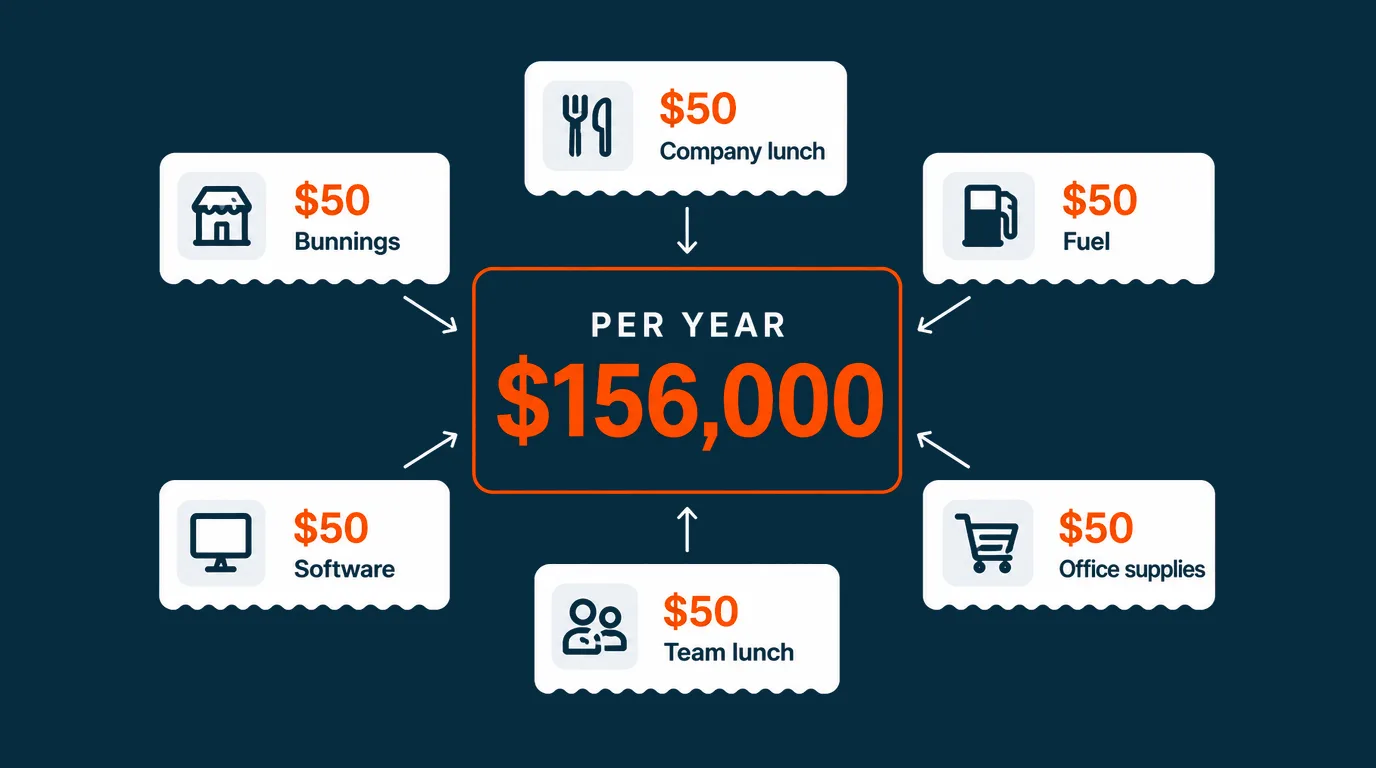
Small spend is where margin quietly disappears
Not in one dramatic decision. In the steady drip of low value purchases that feel harmless in isolation, and become material when your team grows. A …
Your bank balance tells you what already happened. Your budget should tell you what's about to.
Your bank balance is telling you what has already happened. Your budget is meant to tell you what is about to happen. When those two numbers drift …