
PRESS RELEASE
Sydney, Australia, 19 May 2026
Budgetly, the Australian spend management system used by more than 20,000 users across 1,200 businesses, has introduced the Control Loop: a model where every business transaction is controlled before money moves, recorded the moment it executes, and used to improve the next decision. The result is faster month-end, fewer policy violations, and real-time visibility without micromanaging.
The model represents a structural departure from how finance software has traditionally worked.
The problem with traditional expense tools
Most finance software was built around interfaces. Dashboards, reports, and workflows where humans interpret information and make decisions outside the system. The result: finance teams discover policy violations at month-end, chase receipts weeks after the purchase, and spend 3-5 days reconstructing what already happened.
According to Budgetly’s 2026 CFO Survey of 106 Australian finance leaders, 86.8% say manual tasks consume more than 20% of their finance team’s time. Nearly half (49.1%) say it consumes more than 40%.
“The industry has been building reporting tools and calling them control,” said Lisa Callaghan, CFO of Budgetly. “Reporting tells you what happened. Control determines what happens. That distinction matters when you’re trying to prevent overspend, not just measure it.”
How the Control Loop works
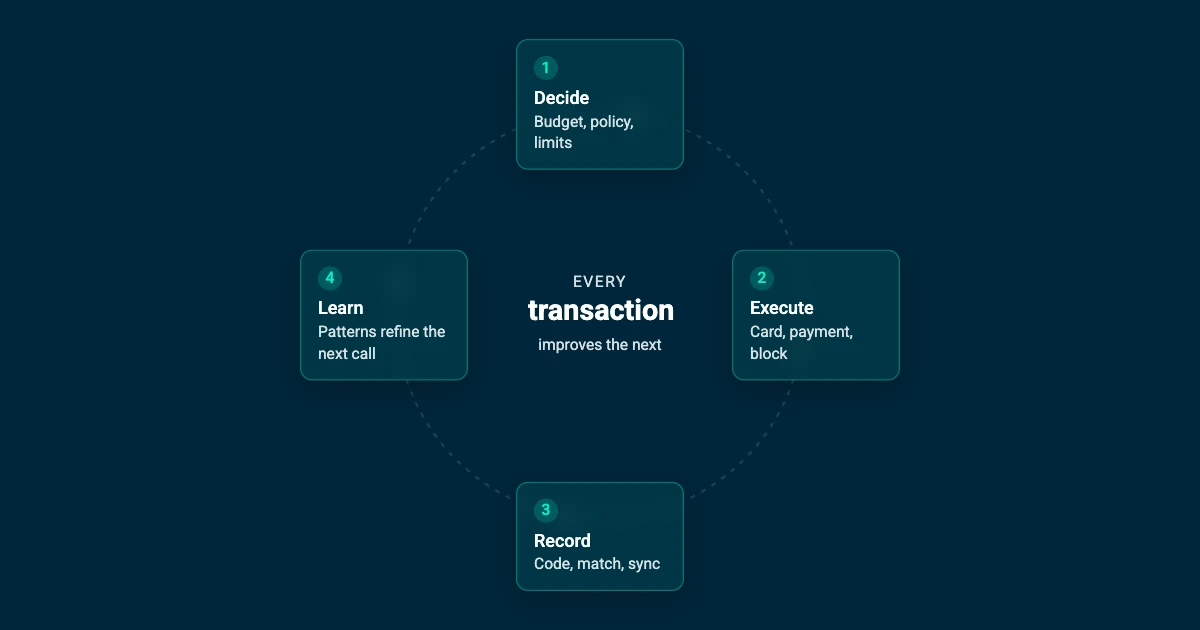
The Control Loop has four stages. There is no terminal step. Each stage feeds forward into the next.
Decide. When a transaction is initiated, the system evaluates it against budget, policy, and approval rules in real time. This is the centre of gravity: the decision moment where the system determines whether money should leave the business, and under what conditions.
Execute. The decision is enforced immediately. Cards approve or decline at the terminal in under 0.3 seconds. The value is not in moving money, but in controlling whether and how it moves.
Record. Financial truth is created at the moment of execution. Categorisation, receipts, GST extraction, and a full audit trail are generated automatically. Bookkeeping becomes the structured memory of decisions, not a separate operational task.
Learn. Patterns are identified, anomalies detected, accuracy improves. Every correction trains the system. Every override refines the routing. Every month-end gets faster. Each transaction strengthens the system’s ability to evaluate the next one.
Why this matters for Australian SMEs
Traditional competitors operate in fragments of this loop. Accounting systems own the Record layer. Card providers and expense tools own Execution. Analytics tools own Intelligence. No single system integrates decision, execution, and record into one real-time loop with intelligence reinforcing it over time.
For finance teams at Australian SMEs with 20 to 200 employees, this fragmentation means:
- Policy violations discovered weeks after the spend
- Receipts chased at month-end, not captured at point of sale
- Budgets in spreadsheets, outdated the moment they’re created
- No audit trail connecting the decision to the transaction to the ledger entry
The Control Loop eliminates these gaps by making every transaction flow through the same continuous system.
The culture shift
The Control Loop also changes the relationship between finance teams and the people who spend. Traditional expense management forces a choice: give employees autonomy and lose control, or maintain control and become the gatekeeper who slows everything down.
“Finance leaders carry this paradox every day,” said Callaghan. “They want to trust their team but the system forces them to chase, check, and reconstruct. The Control Loop resolves that. The system enforces the rules. Employees feel trusted. Finance keeps oversight. Both are true at the same time.”
Results from Australian businesses
Budgetly customers are already operating inside the loop:
- Bawinanga Aboriginal Corporation saves 38 hours per week
- Arkana Energy Group reduced non-essential spending by up to 50%
- Orion Care saves 20 hours per week
- 80% average reduction in manual processing time across the customer base
- 75% faster month-end reconciliation
- 95%+ automatic coding accuracy that compounds with every correction
The compounding effect
Unlike static tools that perform the same way on day one and day one thousand, the Control Loop compounds. Every blocked transaction refines the policy engine. Every approval decision trains the routing. Every anomaly flag improves detection. Every budget cycle sharpens forecasting.
“Most expense tools are flat,” said Callaghan. “They do the same thing on day one as they do a year later. The Control Loop gets smarter with every transaction. Your finance operations compound, not just your revenue.”
Availability
The Control Loop architecture is live across all Budgetly plans. New customers can start a 14-day free trial at budgetly.com.au with no credit card required. Virtual cards are issued in 30 seconds. Most teams are fully onboarded within two weeks.