

Search “virtual credit card Australia” and you get providers competing to issue you a card fast. Almost none of them answer the question underneath it: for a business, is a virtual credit card, a virtual debit card or a prepaid card actually the right tool, and what does each one cost. This guide answers that plainly, then shows how to issue one.
A virtual card is a card number that lives only on a screen, used for online payments and team spending. The three types differ by where the money comes from. A virtual credit card spends borrowed money and charges interest. A prepaid card spends money you load onto it in advance. A virtual debit card spends money the business already holds, with no interest and no preloading. For most Australian SMEs, the debit version does the job the other two are hired for, without the debt or the running-dry.
What is a virtual card?
A virtual card is a digital payment card generated for online transactions and business spending. It exists only in digital form, so there is no plastic to lose or have stolen. Each one has the same details as a physical card:
- A unique 16-digit card number
- An expiry date
- A CVV security code
Banks, fintechs and expense management providers issue them so a business can pay suppliers, run subscriptions and give staff a way to spend without handing around one shared card. You can create a virtual card in seconds, set a limit on it, and freeze or delete it the moment it is no longer needed.
The label “virtual card” says nothing about where the money comes from. That is the part that matters, and it is the next section.
Virtual credit card vs virtual debit card vs prepaid: the honest comparison
The three cards look identical at the checkout. They behave very differently on your books. A bank won’t tell you its credit card is the worse choice for controlled team spending, because credit is what it sells. Debit is what we sell, so here is the comparison straight.
A virtual credit card draws on a line of credit. The business borrows the money and repays it, usually with interest if the balance isn’t cleared. It suits a genuine need to borrow.
A prepaid card holds a balance you load in advance. You can only spend what you have preloaded, and you top it up as it runs down. It caps spending, but the topping up is manual work and the card runs dry at the wrong moment.
A virtual debit card draws directly from money the business already holds. No borrowing, no interest, no preloading, no running dry. You set a budget per card and the card enforces it before the money moves.
| Feature | Virtual credit card | Prepaid card | Virtual debit card |
|---|---|---|---|
| Source of funds | Borrowed line of credit | Balance loaded in advance | Funds the business already holds |
| Interest | Yes, if the balance revolves | None | None |
| Credit check | Required, often with a personal guarantee | Not required | Not required |
| Runs dry | No, up to the credit limit | Yes, until you top it up | No, draws from the account balance |
| Spending control | Limit is a borrowing ceiling | Limited to the preloaded amount | Budget enforced before the money moves |
| Best for | Businesses that genuinely need to borrow | One-off, capped, short-term spend | Team spending within limits you set |
The decision people actually face is credit versus debit, not the word on the card. If you need to borrow, a credit card is the right instrument. If you need your team to spend within a limit you set, and for that spend to show up automatically, credit was never the right tool. A credit limit permits spending up to a ceiling and shows you the damage afterwards. A budget on a debit card stops the spend that breaks it.
What virtual credit cards actually cost an Australian business in 2026
Two costs sit on a business credit card that a debit card doesn’t carry: interest and annual fees. Business card purchase rates in Australia commonly sit around 20% per annum, and annual fees run from roughly $150 to $1,750 per card depending on the product. The rewards that used to offset those costs are shrinking, for a specific Australian reason.
From 1 October 2026, merchants can no longer surcharge card payments on the eftpos, Mastercard or Visa networks, and interchange caps change on the same date. Interchange is the fee that sits inside a merchant’s cost of accepting a card. The new caps make credit structurally more expensive to accept:
- Domestic debit and prepaid, acquired in Australia: 8 cents plus 0.16% of the transaction
- Consumer credit: 0.30% of the transaction
- Commercial credit: 0.80% of the transaction
Read the last two against the first. Commercial credit costs a merchant five times more in interchange than domestic debit. On $500,000 of annual card takings, that is roughly $4,000 a year on commercial credit against about $800 on debit, a difference of around $3,200. Until now a business could recover some of that with a surcharge. From 1 October it comes straight off the margin. The full detail, including the American Express question, is in our guide to what the RBA surcharge ban changes for business cards.
The point for card issuance: rewards programs were funded partly by interchange revenue, so issuers are cutting them back. NAB moved first. If points are the reason a credit card is at the top of your list, check the program after 1 October, not before. A virtual debit card sidesteps the whole question. You spend money you already hold, so there is no interest, no annual card fee, and nothing riding on a rewards program that may not survive the reform.
Interchange figures sourced from the RBA regulatory framework, caps effective 1 October 2026, confirmed as at 8 September 2026.
Work out the yearly cost for your business
The fees and interest above are easy to wave away in the abstract. Put your own numbers in and the gap is concrete: annual fees across your cards, plus interest on anything you carry, against zero on a virtual debit card that spends money the business already holds.
The calculator counts only the two costs a debit card removes outright: annual card fees and interest. It leaves out the merchant-side interchange gap covered above and any rewards, which are shrinking after 1 October. Even on the low end of Australian business card fees, the yearly difference across a team of cards is rarely trivial.
Best virtual card providers in Australia (2026)
Several providers issue virtual cards to Australian businesses. Most sell the card as a payments or FX instrument and stop there. The table below names the main options honestly and frames them on the two things a finance team cares about after issuance: control over how the money is spent, and whether the spend lands in your accounting software coded and receipted.
| Provider | Card type | Spend control | Xero / MYOB integration |
|---|---|---|---|
| Airwallex | Virtual debit | Card limits, mainly built around payments and FX | Xero sync |
| Wise | Virtual debit | Basic card controls, FX-led | Xero sync |
| Revolut Business | Virtual debit | Per-card limits and merchant rules | Xero, QuickBooks |
| Bank-issued (CommBank, NAB) | Virtual credit or debit | Credit limit or account limit, statement-cycle reporting | Feed or manual export |
| Budgetly | Virtual Visa debit | Budget per card enforced before spend, plus receipt capture | Two-way sync to Xero, MYOB and QuickBooks with GST coded |
Fast issuance is table stakes now. Every provider in that table can give you a card number quickly. The difference is what happens after the card is issued: whether the limit is a budget that holds or a ceiling that reports, and whether the transaction reconciles itself or waits for someone to code it at month-end.
When a different provider is the better fit
To be straight about it: if your main problem is paying overseas suppliers in their own currency, an FX-led card from Airwallex or Wise is likely the better fit, because that is what those products are built around. If you genuinely need to borrow to fund the business, a credit card or line of credit is the right instrument, not a debit card. Budgetly is built for the other job most Australian SMEs actually have: giving a team a way to spend within limits you set, in Australian dollars, and having every transaction land in your accounting software coded and receipted. Pick the tool that matches the job in front of you.
How to issue a virtual card for your business
Issuing a virtual card is quick once your account is set up. With Budgetly, the steps are:
- Open a business account. Connect your business bank account. There is no credit check and no personal guarantee, because you are spending your own funds.
- Set a budget for the card. Decide the limit, per person or per department, drawn from money the business already holds.
- Issue the card. Create the virtual Visa debit card and send it straight to the employee’s Apple Pay or Google Pay wallet. It works in about 30 seconds.
- Spend and reconcile. The card declines spend outside its budget, captures the receipt at the point of purchase, and syncs the coded transaction to your accounting software.
That last step is the part most providers leave to you. When a card is issued to one named person with a budget attached, the transaction is already tied to a person and a purpose, so reconciliation happens as the spend lands rather than three weeks later from memory. You can issue a virtual Visa debit card in 30 seconds and set the budget in the same action. If you are moving off a prepaid setup, the same applies to switching from a prepaid card without the topping up.
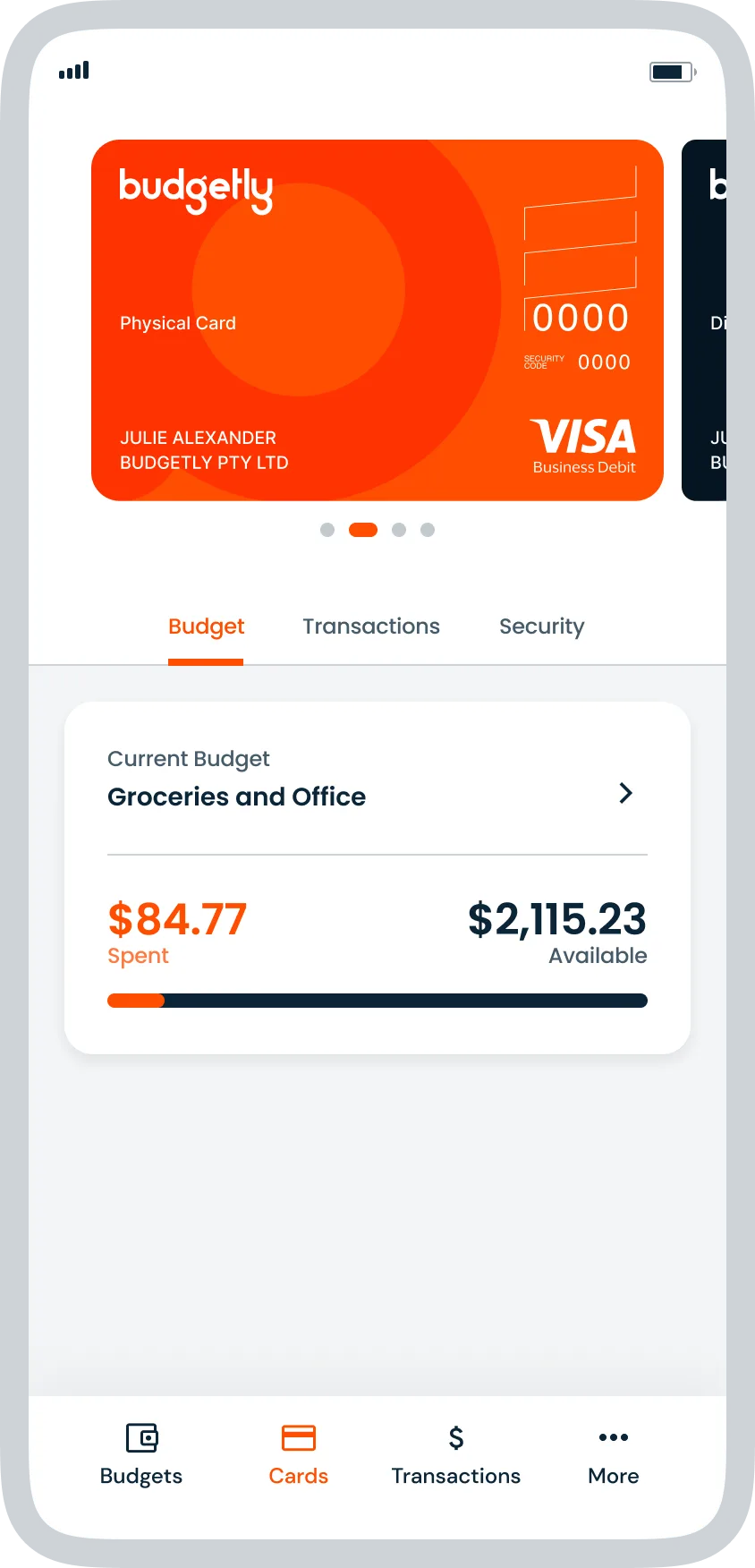
One thing worth being clear on, because businesses ask: the money never leaves your control to sit on a card. There is nothing to preload and no separate card balance to fund. Each virtual card draws directly from the funds your business already holds in its account, and only up to the budget you set on it. That is the practical difference from a prepaid card, where money moves onto the card in advance and stops being spendable anywhere else until you move it back.
Are virtual cards safe? And other questions
Virtual cards are generally safer than a shared physical card, because a virtual card can be locked to one person or one vendor, frozen in a tap, and deleted the moment it is no longer needed. There is no plastic to lose or clone. A few questions come up repeatedly, so here they are directly.
Are virtual cards safe for business use? Yes. Each card has its own number and limit, so exposure is contained to that card. If a number is compromised, you freeze or delete that one card without touching anyone else’s.
What are the disadvantages of a virtual card? Some merchants that require a physical card for verification won’t accept one, and most virtual cards can’t be used for ATM cash withdrawals. Managing many cards can get messy without the right tool, which is where per-card budgets and automatic coding earn their place.
Can I use a virtual card for subscriptions? Yes, and it’s one of the best uses. This is the exact problem Australians keep raising in forums like AusFinance: a single-use or per-vendor card for online subscriptions, so one SaaS tool or ad account can’t quietly rack up charges. A dedicated card per subscription caps the spend to a budget, and an unwanted renewal is stopped by deleting the card rather than hunting for a cancel button. Because it’s a debit card, the subscription also can’t push the business into interest-bearing debt while nobody’s watching.
Can I give my team virtual cards without a credit check? Yes, with a debit card. Because a virtual debit card spends funds the business already holds, there is no credit assessment and no personal guarantee. A business that opened its account this week can issue cards the same day. Issuing cards to a whole team is the corporate card job, one card per person rather than one shared between five.
The Budgetly difference: the card is the easy part
Every provider can issue a card fast. Fast issuance is not the hard part of business spending, and it is not where the money leaks. The hard part is control before the spend and reconciliation after it, and most virtual card products barely touch either.
Budgetly treats the card as one node in a spend-control loop. You set a budget once. The card enforces it before the money moves, rather than letting spend through and flagging it on a statement. The receipt is captured at the point of purchase. The transaction syncs to Xero, MYOB or QuickBooks already coded, with GST treatment and the receipt attached. No interest, no annual card fee, no credit check, no personal guarantee, because you are spending money the business already holds.
The results show up in time, not adjectives. Bawinanga Aboriginal Corporation recovered 38 hours a week previously lost to reimbursements and receipt chasing. Arvensis Research moved off a complicated bank credit card process onto virtual Visa debit cards it can issue itself. And on the cost side, the interchange maths above is not hypothetical: a business putting $500,000 a year through commercial credit cards pays roughly $3,200 more in embedded card costs than it would on debit, before a cent of interest or annual fees. Budgetly is used by more than 20,000 people, holds 99% customer retention, and rates 4.9 on Capterra across 132 reviews.