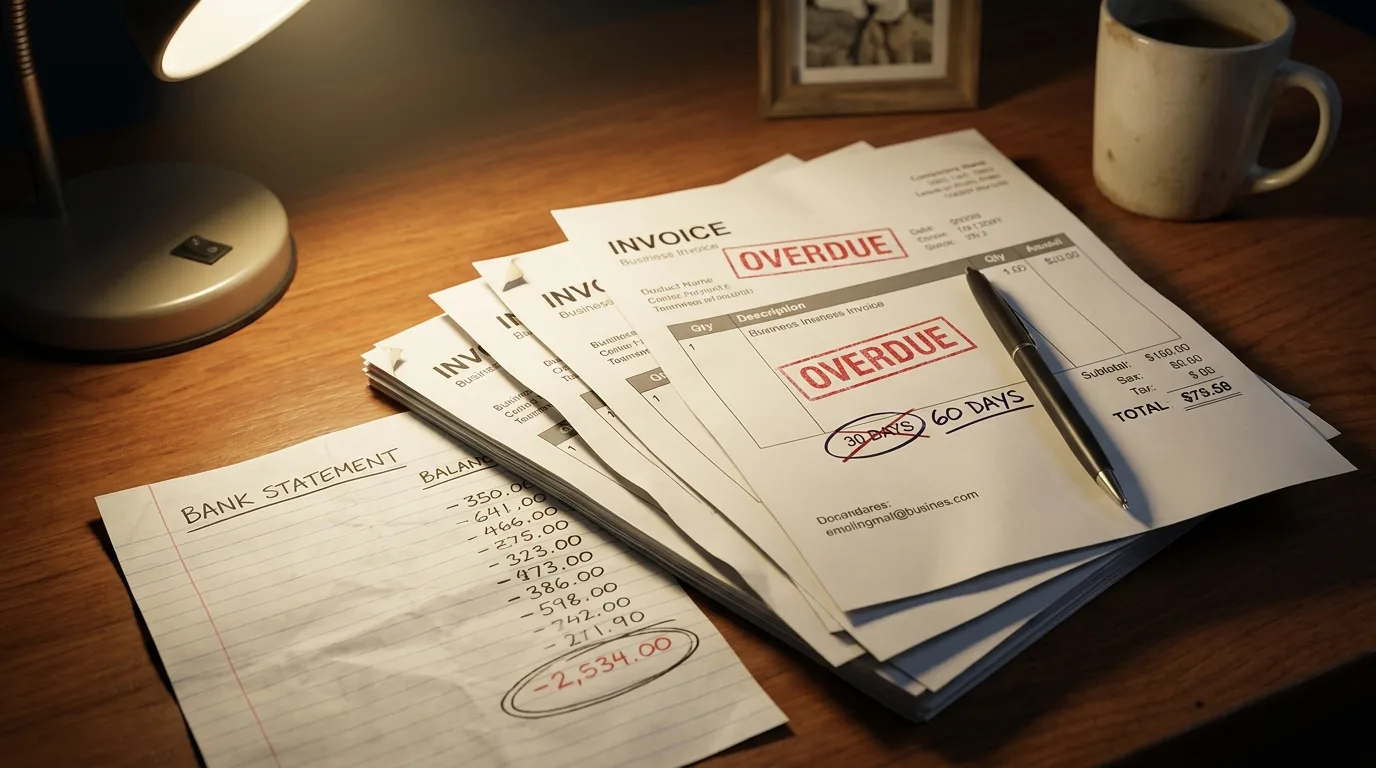


Your P&L looks profitable. Your bank balance tells a different story. NAB’s SME survey puts cash flow as the number one concern for 43% of Australian small and medium businesses, and this gap is why.
The P&L records revenue the moment you invoice it. Cash flow records it the moment money lands in your account. For any business with annual contracts, quarterly billing, or seasonal demand, the space between those two moments can stretch across months. You can be profitable on paper and unable to make payroll in the same week.
The problem is visibility, not maths
A traditional 12 month budget assumes revenue arrives in even slices. A business that invoices quarterly but pays staff and suppliers weekly drifts out of sync almost immediately. The cost is real: missed supplier payments, a scramble for short term finance, a hire frozen at the wrong moment. None of that is bad arithmetic. It is not seeing the trough before you fall into it.
The 13 week rolling forecast fixes that. It replaces the calendar year view with a continuous window that rolls forward one week at a time, treats lumpy revenue as normal, and surfaces a shortfall while you still have time to act.
Why 13 weeks
Far enough ahead to do something: secure a facility, renegotiate terms, pull an invoice forward. Close enough that your estimates are grounded in real pipeline, not the fiction a 12 month projection becomes by month seven. Each week, the front hardens into fact and a fresh week drops onto the far end.
The structure: three horizons of decreasing certainty
Weeks 1 to 4: committed. Invoices issued, contracts signed, spend approved. Use actuals, not forecasts.
Weeks 5 to 8: probable. Pipeline likely to close, operating spend on historical patterns. Forecast conservatively. Better a pleasant surprise than a wall.
Weeks 9 to 13: indicative. Seasonality and known milestones. Early warning signals, not commitments.
Then the line that runs the business: the cumulative position. Cash in minus cash out, carried forward week by week. When it dips toward zero, you act. Because you are looking 13 weeks out, you act early.
Adapt the shape to your revenue
Annual contracts with monthly billing: lay each payment schedule onto the calendar as its own line.
Quarterly billing with monthly spend: watch the cumulative line sag before each invoice clears. Those sags are where businesses reach for expensive money.
Seasonal: build off last year’s actuals, adjusted for growth.
Run it as a ritual, not a one-off
Block 30 minutes on the same day each week, roll the window forward, and replace estimates with actuals as they land. The usual traps are optimistic revenue, forgotten lumpy outflows like BAS and annual renewals, and building it once then never touching it again.
If you want a weekly finance checklist to pair with the forecast review, that one covers the operational layer: exceptions, missing receipts, budgets, and top merchants.
With Payday Super now live, the forecast is where you spot the double-hit before it becomes a BAS payment plan.
The bottom line
Cash is not a reporting problem you clean up at month end. It is a control you exercise in advance. The businesses that never get blindsided are not the ones with the most cash. They are the ones who saw the trough coming and had time to move.