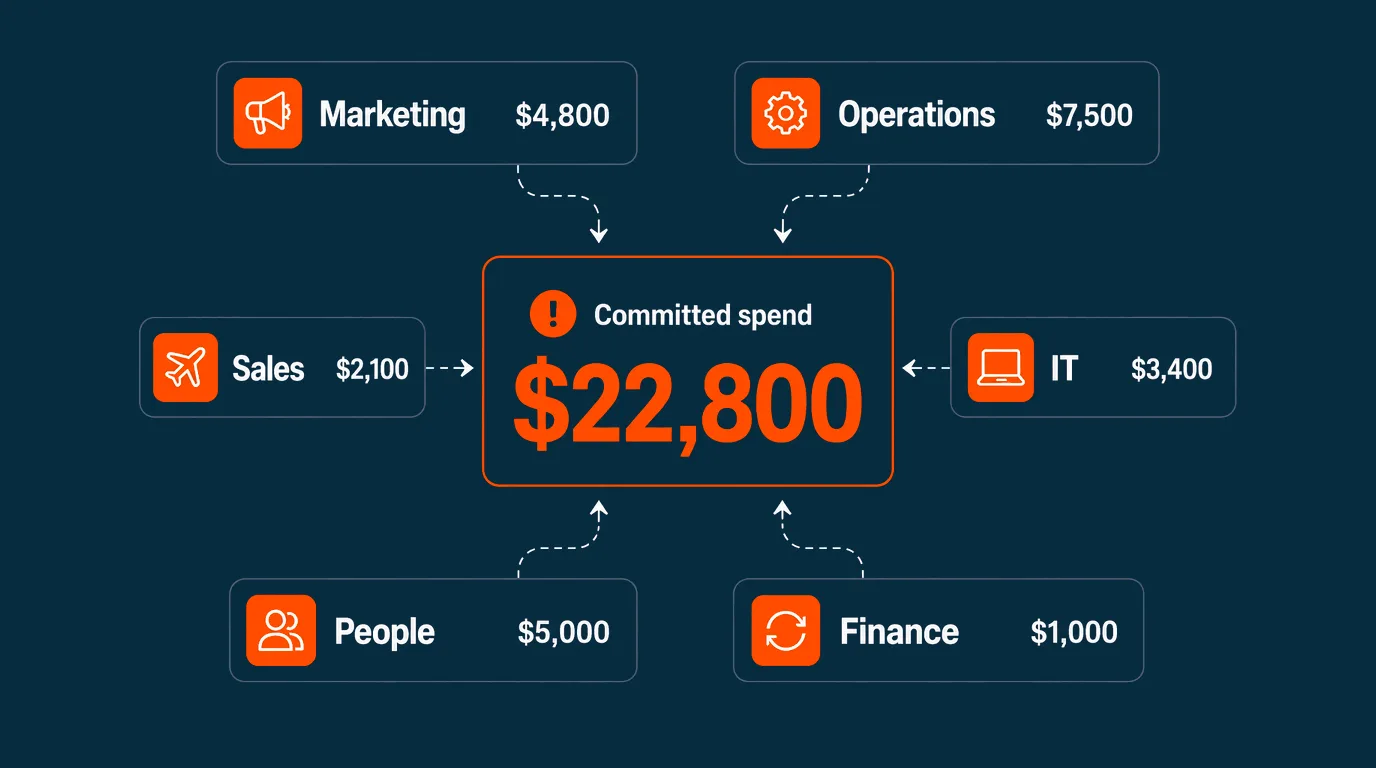


Your forecast says one thing. Your bank account says another. The gap between the two almost always traces back to spend that nobody tracked until it was too late.
Most finance teams at Australian SMEs run a monthly reconciliation cycle. They pull statements, chase receipts, match transactions, and discover the damage. By then, the budget is blown and the cash flow forecast is fiction.
The fix is not a better forecasting model. It is earlier visibility into what is already happening.
Why cash flow surprises start with spend
Cash flow is not just revenue timing. It is the outcome of how reliably your finance team can answer three questions at any point in the month:
- What have we committed to this month?
- What has already been spent?
- What is trending over budget right now?
When spend is decentralised across departments, cards, and bill payments, those answers arrive late. The forecast becomes an educated guess. And educated guesses are where cash flow surprises come from.
The Budgetly CFO Survey (March 2026) found that 49.1% of SME finance leaders say manual tasks consume 40% or more of their team’s time. That is time spent reconciling, chasing, and correcting rather than forecasting and deciding.
The weekly spend risk review (30 minutes)
A short, structured weekly review surfaces spend risk before it becomes a cash flow problem. Five checks, 30 minutes, done before Tuesday morning.
1. Budget burn rate: are we spending too fast?
Pull up each active budget and compare actual spend against the monthly allocation. The signal is simple: if a budget is 60% used halfway through the month, it needs attention now.
| Signal | What it means | Action |
|---|---|---|
| Budget under 50% at mid-month | On track | No action needed |
| Budget at 50-70% at mid-month | Watch closely | Flag to budget owner |
| Budget over 70% at mid-month | Likely to overshoot | Freeze or reallocate before month-end |
This takes two minutes per budget when you have real-time budget visibility. Without it, you are waiting for the statement.
2. Exceptions: the spend that was not planned
Exceptions are where forecasts drift. An exception is any transaction that falls outside the normal pattern: an unusually large purchase, a new supplier, a category that does not match the budget.
Track weekly:
- Number of exceptions raised
- Total exception value
- Repeat categories or merchants
Exceptions are not inherently bad. But untracked exceptions are invisible risk. One unnoticed $2,000 exception per week is $8,000 per month that never made it into the forecast.
3. Missing receipts and uncoded transactions
If transactions are not complete, reporting is delayed. Delayed reporting means delayed forecasting.
A weekly count of missing receipts and uncoded transactions tells you how much of your spend picture is still incomplete. If 30% of last week’s transactions are missing receipts, your month-end close is already behind.
This is one of the most common drains on finance teams. Bawinanga Aboriginal Corporation was spending 38 hours per week on manual admin before they replaced their receipt chasing process with automated capture.
4. Top merchants and new suppliers
New suppliers can indicate:
- New recurring spend that has not been budgeted
- Shadow subscriptions creeping in
- Project scope creep showing up in the numbers
A quick scan of top merchants and any new names on the list takes two minutes. If a supplier you have never seen before appears three weeks in a row, that is a new recurring cost that needs a budget line.
5. Approval queues: future spend waiting to happen
Pending approvals are a forward-looking signal. If approvals are stacking up, the business is about to spend, whether finance is ready or not.
A growing approval queue is a leading indicator of cash outflow. Review the queue weekly and ask: if every pending approval is granted, does the budget still hold?
What changes when finance reviews spend weekly
The difference between monthly and weekly spend reviews is not just frequency. It changes what finance can do about the problems they find.
| Monthly review | Weekly review |
|---|---|
| Discover overspend after the money is gone | Catch budget drift while there is still time to act |
| Chase receipts in bulk at month-end | Flag missing receipts within days of the transaction |
| Reconcile exceptions after the fact | Investigate exceptions while context is fresh |
| Forecast based on last month’s actuals | Forecast based on this week’s real spend data |
| Month-end close takes 3-5 days | Month-end close is mostly done before it starts |
The shift from reactive to proactive does not require a new forecasting model. It requires earlier visibility into what is already happening.
Real results from earlier spend visibility
Finance teams that moved from monthly to real-time spend visibility report consistent results:
- Bawinanga Aboriginal Corporation eliminated 38 hours per week of manual admin by replacing receipt chasing and reimbursements with pre-approved cards and automated capture
- Connecting Families saved over $21,000 by switching from shared bank cards to individual spend controls with real-time visibility
- Faith Christian School recovered one full week per month that was previously lost to manual reconciliation
These are not efficiency gains from a new tool. They are the result of replacing a broken workflow: waiting until month-end to see what happened, then scrambling to fix it.
The pattern is the same across industries. When finance can see spend as it happens, overspend drops, receipts arrive on time, and the month-end close shrinks from days to hours.
How to start this week
You do not need new software to run your first weekly spend review. Open your accounting system, pull the five data points above, and spend 30 minutes on Monday morning.
But if you find that the data is late, incomplete, or scattered across bank statements and email threads, that is the signal. The review is only as good as the visibility behind it.
Prevent overspending before it happens covers the control side of this equation: how to set budgets and rules that stop overspend at the point of purchase, not after the fact.