
AI spend is catching finance teams off guard for one simple reason. It behaves nothing like the software cost lines most budgets are built on.
Seat based software is predictable. You buy 20 seats, you pay for 20 seats. The main variable is headcount. AI is different. Most modern AI costs are usage based, and usage rises with success. The more valuable the feature, the more it is used, and the bigger the bill becomes.
That dynamic is now showing up in the data. The FinOps Foundation’s State of FinOps 2026 report found that 73% of organisations said their AI costs exceeded original projections. That result was drawn from over 1,192 practitioners managing more than $83 billion in annual cloud spend. Source: The Source Code.
If teams managing spend at that scale are missing their forecasts, SMEs need a different approach from day one.
The first misconception is where the cost sits
Many leaders still assume AI cost is about training. It is not. Inference is where the real money goes. Inference, not training, accounts for 80% to 90% of AI expenditure.
Inference cost is the cost of the model running in production, every time a user clicks, asks, generates, summarises, drafts, or triggers an automated workflow. It is metered in tokens, which are a proxy for input and output volume. That means cost is linked to behaviour, not contracts.
This is why AI cost is hard to forecast with traditional tools. A CFO can forecast payroll. A CFO can forecast subscriptions. Forecasting inference requires understanding usage patterns, prompt length, model choice, and how many times a workflow runs.
The second misconception is that success is cheap
With token based pricing, your best case and worst case can be miles apart.
Best case looks like a pilot. A small group uses the tool occasionally. Prompts are short. Responses are short. The feature feels cheap.
Worst case looks like adoption. The tool becomes core workflow. Prompts grow as people add more context. Outputs grow as people rely on the model more. Automation becomes agentic, and starts executing repeatedly without a human noticing each run.
This is why AI breaks the seat pricing mental model. Cost does not scale with people. It scales with behaviour.
The core failure is one of sequence
The most common failure pattern is simple.
Teams ship AI features first, and measure the cost afterwards.
That approach is survivable at small scale. It stops being survivable once usage becomes agentic and executes thousands of times a day against a bill nobody modelled.
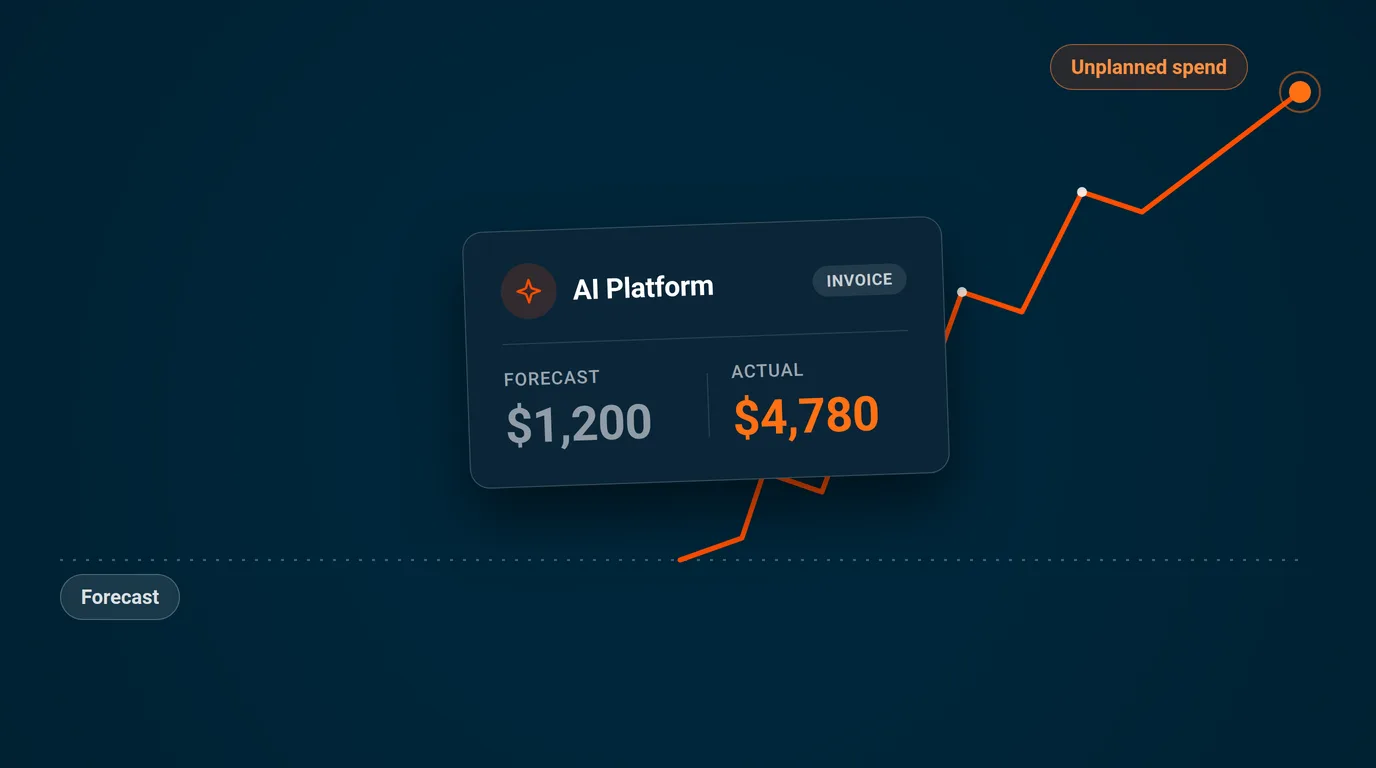
By the time the invoice arrives, the business has already built dependency. The feature is in the workflow. People expect it. Removing it creates friction. Finance is left negotiating after the decision has been made.
This is exactly the spend control problem CFOs already understand. Control after the spend is not control. It is reporting.
What SMEs should do before switching on AI
You do not need enterprise FinOps to avoid surprises. You need the right questions upfront.
Ask for unit cost per use, not just subscription price
If a vendor sells “AI included”, ask how usage is metered and what drives cost. What is the cost per summary, per generated document, per ticket resolved, per analysis run. If the vendor cannot answer, treat that as risk.
Model against your busiest realistic month, not your average month
Average months do not blow budgets. Peaks do. Model a worst case month based on what success would look like. If adoption doubles, what happens. If usage is ten times, what happens. If you cannot afford the busy month, you cannot afford the rollout.
Put a ceiling in place before launch
Decide what “too much” looks like at a feature level. If usage crosses the ceiling, do you throttle, degrade to a cheaper model, require approval, or restrict to certain roles. Make the decision now, not after the invoice.
The headline is simple. AI can deliver meaningful productivity gains, but it introduces a new class of spend risk. Treat it like any other variable cost line. Understand unit economics, model the peak, and set guardrails before you scale.