
If your drivers are filling up on personal cards, sharing a single fleet card across the team, or submitting fuel receipts weeks after the fact, you already know how quickly fuel spending can get away from you. This guide covers every fuel card option available to Australian businesses in 2026, from traditional branded network cards through to prepaid expense cards with fuel controls. By the end you will know exactly which card type suits your business, what to look for, and how to avoid the most common mistakes.
Who this guide is for
This guide is written for Australian business owners, fleet managers, finance teams, and operations leaders who need a better way to manage fuel spending. Whether you run two vehicles or two hundred, you will find practical information about how fuel cards work, what they cost, and which features actually matter.
You do not need any existing knowledge of fuel cards to follow this guide. If you already have a fuel card and want to evaluate whether it is still the best option, the comparison sections will help you benchmark your current arrangement.
Traditional fuel cards vs Visa business expense cards
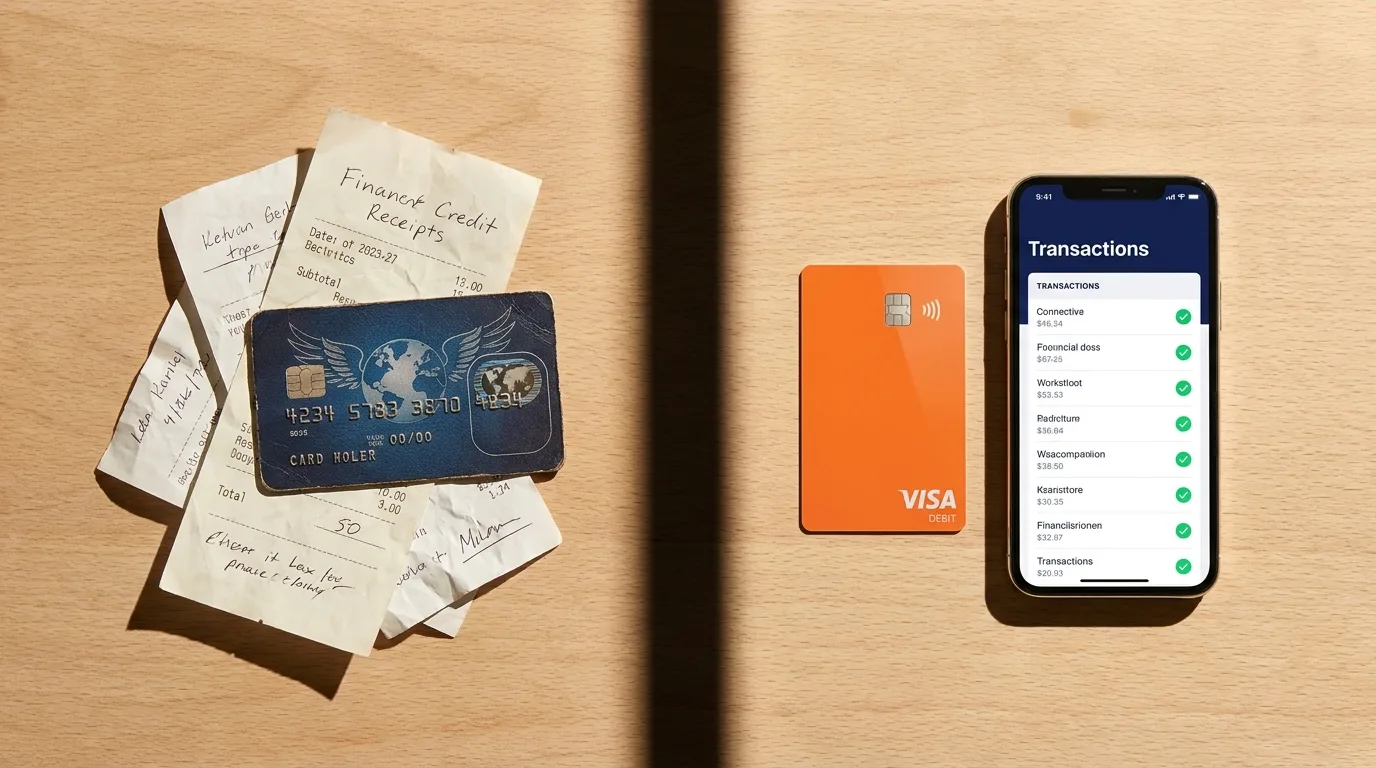
The following comparison highlights the practical differences between traditional branded fuel cards and Visa-based prepaid expense cards configured for fuel spending.
Make sure your team can fill up, anywhere.
Set the rules. We enforce them in real time.
Save hours every week on admin.
The right choice depends on what matters most to your business. If per-litre discounts on high-volume purchasing are your primary concern and your drivers operate within a single brand’s coverage area, traditional cards may suit. If coverage, control, visibility, and administrative simplicity matter more, prepaid Visa cards offer a stronger overall proposition.
Australian business fuel cards compared
The table below compares the main fuel card products available to Australian businesses in 2026, including both traditional fuel cards and prepaid expense card alternatives.
Last reviewed: August 2026
Compare side by side
Select 2 or more to compare.
 BP Plus
Branded network
BP Plus
Branded network| Acceptance | 1,400+ BP sites nationally |
|---|---|
| Account / card fees | Card service fee (varies by payment method; nil via eligible AmEx payment) |
| Fuel discounts | Introductory per-litre discount offers, time-limited |
| Spending controls | Card-level limits via BP Plus Online |
| Reporting | Consolidated GST-substantiated statement, 24/7 online reporting |
| Accounting integrations | Statement export |
| Requirements | Business credit application |
 Shell Card
Branded network
Shell Card
Branded network| Acceptance | 1,600+ Shell and Coles Express sites |
|---|---|
| Account / card fees | Around $2.50 per card, per month (promotional waivers available) |
| Fuel discounts | Introductory per-litre discount offers, time-limited |
| Spending controls | Card-level limits |
| Reporting | Monthly statement, online account access |
| Accounting integrations | Statement export |
| Requirements | Business credit application |
 AmpolCard
Branded network
AmpolCard
Branded network| Acceptance | Around 1,800 Ampol sites nationally |
|---|---|
| Account / card fees | Around $2.95 per vehicle, per month |
| Fuel discounts | Introductory per-litre discount offers (typically 6-8c/L for a fixed term) |
| Spending controls | Card-level limits |
| Reporting | Monthly statement, online account access |
| Accounting integrations | Statement export |
| Requirements | Business credit application |
| Acceptance | Around 95% of Australian service stations |
|---|---|
| Account / card fees | Monthly card management fee, tiered from around $6 down to $4.50 per card by fleet size, plus a transaction fee |
| Fuel discounts | Site-dependent discounts, some partner offers |
| Spending controls | Fleet management controls, card-level and account-level limits |
| Reporting | Dedicated fleet reporting dashboard |
| Accounting integrations | Statement export |
| Requirements | Business application, no widely-advertised credit check requirement |
 Budgetly (Visa business debit)
Visa business expense card
Budgetly (Visa business debit)
Visa business expense card| Acceptance | Any station that accepts Visa, Australia-wide |
|---|---|
| Account / card fees | Flat monthly platform fee plus a per-active-card rate, no per-transaction surcharge |
| Fuel discounts | None (pays retail pump price, no fuel-specific discount) |
| Spending controls | Per-driver daily, weekly or monthly limits; configurable merchant category rules |
| Reporting | Real-time dashboard and mobile notifications |
| Accounting integrations | Automatic Xero, MYOB and QuickBooks sync |
| Requirements | Standard business verification, no credit check (prepaid/debit, not credit) |
Each product has strengths for specific use cases. The best card for your business depends on your fleet size, geographic spread, control requirements, and tolerance for administrative overhead. For a deeper look at how to manage whichever card you choose, see our fuel expense management guide.
What is a business fuel card?
A business fuel card is a payment card issued to employees specifically for purchasing fuel on behalf of the company. Instead of drivers paying out of pocket and submitting reimbursement claims, the card charges the business directly at the point of purchase.
Fuel cards sit between the business and the fuel supplier, creating a clean audit trail for every fill. The business retains ownership of the card, sets the spending parameters, and receives consolidated reporting on all fuel purchases across the team.
In practice, a fuel card removes three friction points from the fuel purchasing process:
- For drivers: no personal money at risk, no receipts to collect and submit later
- For finance teams: no reimbursement processing, no chasing paper dockets
- For managers: visibility into who spent what, where, and when
The fuel card market in Australia has evolved significantly over the past decade. Where once the only option was a branded network card from BP or Shell, businesses now choose from multi-network cards, bank-issued fleet products, and modern prepaid expense cards that combine fuel controls with broader spend management capabilities.
How do fuel cards work?
The mechanics of a fuel card are straightforward. Here is what happens during a typical fuel card transaction:
- The driver fills up at a service station that accepts their card type
- The terminal authorises the transaction against the card’s available balance or credit limit
- The business receives a notification (in real time for modern cards, or on the next statement for traditional cards)
- The transaction is coded to the correct cost centre, vehicle, or driver
- The receipt is captured (automatically via app, or manually via paper docket)
- The transaction flows into accounting software for reconciliation
Traditional fuel cards operate on a credit model. The fuel company extends a line of credit to the business, drivers transact against that credit, and the business pays the account monthly. This mirrors how a credit card works, including the credit checks and director guarantees that come with it.
Prepaid fuel cards (including prepaid expense cards with fuel controls) work differently. The business loads funds onto the card in advance. Drivers spend from the available balance. There is no credit facility, no interest charges, and no personal liability for drivers or directors.
Both models achieve the same outcome for the driver at the pump. The difference is in the financial structure behind the card and the level of control the business retains over spending.
Who can get a fuel card in Australia?
Eligibility depends on the type of fuel card you are applying for.
Traditional branded fuel cards (BP, Shell, Ampol, 7-Eleven) typically require:
- An active ABN registered for at least 6 to 12 months
- A satisfactory credit history (a credit check is standard)
- A director guarantee or personal guarantee for the credit facility
- A minimum monthly fuel spend in some cases (usually $500 or more)
Multi-network cards (Motorpass, Fleetcard) have similar requirements, as they also operate on credit facilities.
Prepaid expense cards with fuel controls (such as Budgetly) have far lower barriers:
- An active ABN (no minimum trading history)
- No credit check required (the card is prepaid, not credit)
- No personal guarantee from directors
- No minimum spend requirement
- Sole traders, partnerships, companies, and trusts are all eligible
This makes prepaid cards accessible to newer businesses, contractors, sole traders, and organisations that cannot or do not want to take on credit facilities. Businesses with existing credit constraints or those that prefer to avoid director exposure often find prepaid cards are the only viable option.
Types of fuel cards in Australia
The Australian market offers four distinct categories of fuel card, each with trade-offs in coverage, control, and cost.
1. Branded network cards
Issued by fuel companies and restricted to their own station network. The major options are BP Plus, Shell Card, Ampol Card, and 7-Eleven Fleet Card. These cards lock you into a single brand. If your drivers work in areas without that brand’s stations, the card cannot be used.
2. Multi-network cards
Products like Motorpass and Fleetcard work across multiple fuel brands, offering broader geographic coverage. They still restrict spending to fuel and automotive categories, and they still operate on credit facilities with the associated checks and guarantees.
3. Bank-issued fleet cards
Some business banking packages include fleet card products as part of a broader commercial lending relationship. These typically sit within existing credit facilities and may offer integration with the bank’s business accounts, but they carry the same credit and guarantee requirements as branded cards.
4. Prepaid expense cards with fuel controls
Modern alternatives like Budgetly issue individual prepaid Visa cards to each driver. The cards work everywhere Visa is accepted, but you can set merchant category restrictions so they only approve transactions at fuel stations. No credit checks, no personal liability, and no lock-in to a single fuel network.
How to choose the right fuel card for your business
Selecting the right fuel card comes down to matching the product to your operational reality. Consider these factors:
- Fleet size and geography: Do your drivers stay in metro areas (where all brands have coverage) or travel regionally (where branded networks have gaps)?
- Spending categories: Do drivers only buy fuel, or do they also purchase materials, tolls, parking, or supplies?
- Control requirements: Do you need per-driver limits, or is a fleet-wide credit limit sufficient?
- Receipt management: Can you accept paper-based receipt processes, or do you need automatic digital capture?
- Accounting integration: Does the card sync with your accounting platform (Xero, MYOB, QuickBooks), or does it require manual data entry?
- Credit appetite: Are you comfortable with a credit facility and director guarantee, or do you prefer a prepaid model with no credit risk?
- Onboarding speed: Can you wait 5 to 10 days for card delivery, or do you need drivers set up within minutes?
- Reporting needs: Do you need real-time transaction visibility, or is a monthly statement acceptable?
For most Australian SMEs running fewer than 50 vehicles, the combination of broad acceptance, per-driver controls, automatic receipt capture, and accounting integration makes prepaid expense cards the stronger choice. Larger fleets with dedicated fuel depots or negotiated bulk pricing may still benefit from traditional branded arrangements.
Fuel card acceptance and coverage
One of the most important differences between fuel card types is where they are accepted. A card that locks you into a single brand network creates coverage gaps that directly affect your drivers.
Only works at that brand's own stations.
Works wherever Visa is accepted.
Illustrative coverage model. Not literal station counts or market share.
Branded network cards restrict drivers to stations carrying that brand. In metro areas this is rarely a problem, but in regional and rural Australia the nearest branded station can be 100km or more away. Multi-network cards improve coverage but still limit transactions to participating fuel retailers.
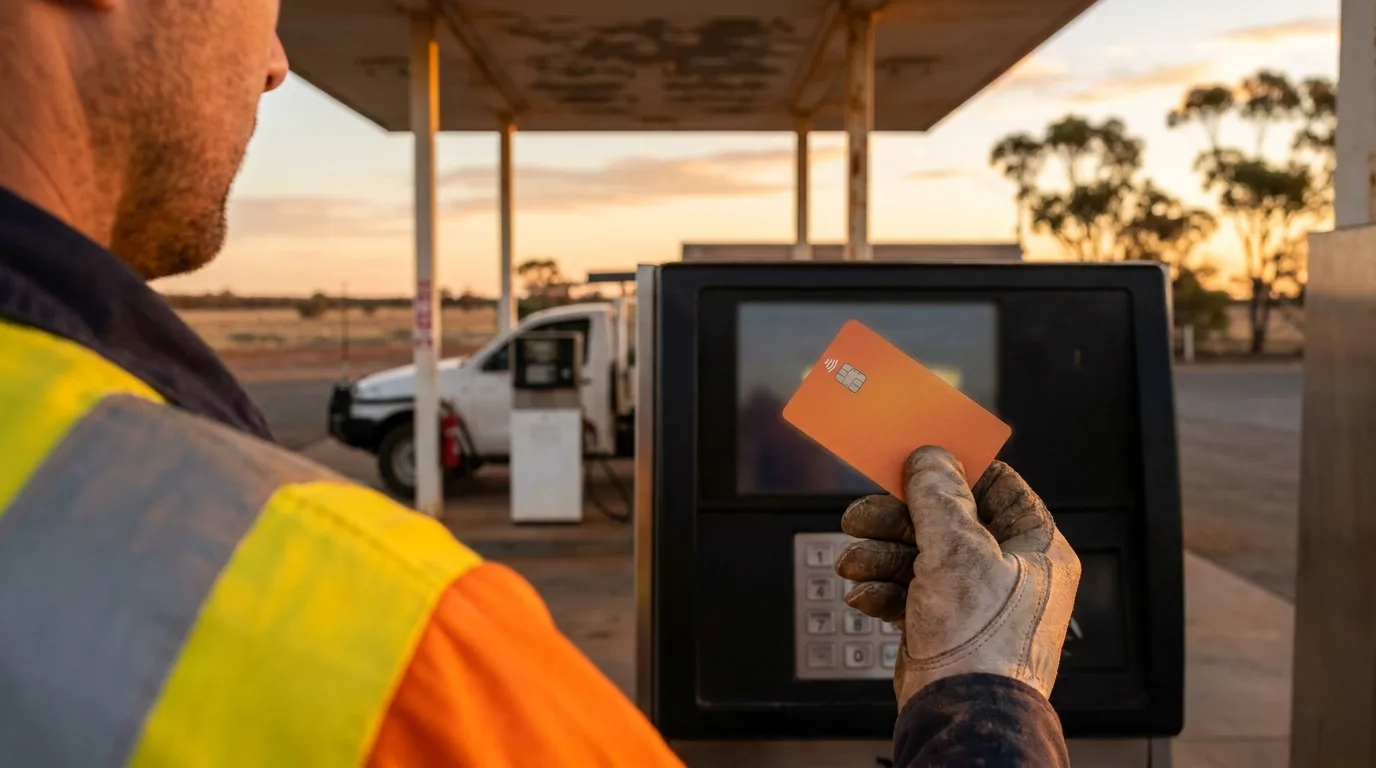
Visa-based prepaid cards (including Budgetly fuel cards) work at every service station in Australia that accepts Visa, which is effectively all of them. This eliminates coverage gaps entirely and means drivers are never stranded because their card brand is not available.
How much do fuel cards cost?
Fuel card costs are not always transparent. Here are the fee categories you should evaluate when comparing products.
Traditional fuel card fees:
| Fee type | Typical range |
|---|---|
| Monthly account fee | $0 to $5 per card |
| Transaction fee | $0 to $0.50 per fill |
| Late payment fee | $15 to $50 |
| Card replacement | $10 to $25 |
| Credit facility interest | 15% to 22% p.a. |
| Per-litre discount | 2c to 8c off pump price (conditional on volume) |
Prepaid expense card fees:
| Fee type | Typical range |
|---|---|
| Monthly platform fee | Flat monthly fee per business |
| Per-card fee | $10 per active card per month |
| Transaction fees | Nil |
| Late payment fees | N/A (prepaid model) |
| Per-litre discount | None (pays retail pump price) |
The savings case for prepaid cards rests on eliminated labour rather than per-litre discounts. Automatic reconciliation, digital receipt capture, and real-time reporting typically save 4 to 10 hours per week for a 10 to 20 vehicle fleet. At average finance team labour costs, this exceeds any fuel discount within the first month of use.
For businesses spending over 50,000 litres per month at a single brand, negotiated volume discounts on traditional cards can be significant. Below that threshold, the administrative overhead of traditional cards usually outweighs the per-litre savings.
Fuel cards for fleets
Fleet operators have specific requirements that go beyond what individual drivers need. When evaluating fuel cards for fleet use, consider:
- Vehicle-level tracking: Can you assign spend to specific vehicles (not just drivers) for accurate per-vehicle cost reporting?
- Odometer capture: Does the card system capture odometer readings at each fill to calculate fuel efficiency?
- Driver assignment: Can cards be reassigned when drivers change vehicles or leave the business?
- Fleet-wide reporting: Can you view total fleet fuel spend, average cost per kilometre, and identify outliers?
- Integration with fleet management: Does the card connect with your existing telematics or fleet management platform?
Prepaid expense cards with fleet-specific configurations let you create budgets per vehicle, set daily fill limits based on tank capacity, and flag anomalous transactions (such as a vehicle with a 60L tank recording a 90L fill). This level of control is difficult to achieve with traditional cards that operate on a single account-wide credit limit.
For detailed guidance on managing fleet fuel expenses, including driver accountability frameworks and reporting structures, see our fleet fuel management section.
Fuel cards and GST/BAS
Fuel purchases attract GST, and most businesses can claim input tax credits on fuel used for business purposes. The ATO requires valid tax invoices (receipts) for purchases over $82.50 to claim the GST credit.
This is where fuel card choice directly affects your bottom line:
- With automatic receipt capture: Every fuel receipt is digitised at point of purchase and matched to the transaction. At BAS time, you have a complete set of tax invoices ready to support your GST claims. Missed claims become rare.
- Without automatic receipt capture: Drivers keep paper dockets (or forget to). At BAS time, your bookkeeper chases missing receipts. Any receipt that cannot be located means a forfeited GST credit, typically $5 to $15 per missing receipt.
For a fleet of 20 drivers filling up twice per week, even a 10% receipt loss rate means 16 missing receipts per month. At an average GST credit of $8 per receipt, that is $128 per month in forfeited claims, or over $1,500 per year.
Fuel tax credits (for heavy vehicles over 4.5 tonnes GVM or off-road use) require accurate litre records. Cards that capture volume data automatically simplify this claim process. To estimate what you can claim at the ATO rate for the date you bought the fuel, use our fuel tax credit calculator.
For a complete breakdown of fuel cards and BAS reporting requirements, see our BAS reporting section.
Fuel card security and fraud prevention
Fuel card fraud costs Australian businesses millions each year. Common fraud vectors include:
- Unauthorised personal use: Drivers filling personal vehicles on the company card
- Card skimming: Card details stolen at compromised terminals
- Over-billing: Attendant-assisted fills where the pump is not reset between customers
- Card sharing: Shared cards used by unauthorised individuals with no accountability
Modern fuel cards mitigate these risks through layered controls:
- Per-driver cards eliminate sharing and create individual accountability
- Merchant category restrictions ensure the card only works at fuel stations
- Daily and transaction limits cap exposure if a card is compromised
- Real-time notifications alert managers to every transaction as it occurs
- GPS matching (available on some platforms) compares transaction location to the driver’s known route
- Instant freeze capability lets you disable a card in seconds if fraud is suspected
Traditional fuel cards offer some of these features (particularly transaction limits), but the real-time alerting, instant freeze, and merchant category controls are typically stronger on modern prepaid platforms.
How to apply for a fuel card
The application process varies significantly by card type.
Traditional fuel cards (BP, Shell, Ampol, 7-Eleven, Motorpass):
- Complete an online or paper application form
- Provide business details including ABN, trading history, and financial references
- Undergo a credit assessment (may take 3 to 5 business days)
- Sign the agreement including any director guarantee
- Wait for cards to be printed and delivered (5 to 10 business days)
- Activate cards and distribute to drivers
Prepaid expense cards with fuel controls (Budgetly):
- Sign up online with your ABN and business details
- Complete identity verification (typically same day)
- Issue virtual cards to drivers instantly via the app
- Configure fuel-only merchant category restrictions
- Set per-driver spending limits
- Drivers download the app and start transacting immediately
The difference in onboarding speed matters when you need to get a new driver on the road quickly. With traditional cards, a new hire may wait up to two weeks before they can fuel up on the company account. With prepaid cards, they can be transacting within minutes of their first day.
Fuel card alternatives
Not every business needs a dedicated fuel card. Here are the alternatives and when they make sense:
Prepaid expense cards (the leading alternative): Issue a Budgetly card to each driver with fuel category restrictions. This is not a traditional fuel card, but it solves the same problem while adding broader expense management capabilities. Ideal for businesses where drivers purchase more than just fuel.
Corporate credit cards: Issue a corporate credit card with a fuel allocation. Works for small teams where individual accountability is less important and you are comfortable with credit exposure. Offers no fuel-specific controls.
Reimbursements: Drivers pay personally and claim back later. The worst option for driver experience, cash flow, receipt compliance, and finance team workload. Still used by many Australian businesses simply because they have not explored alternatives.
Petty cash: Pre-loaded cash given to drivers for fuel purchases. Creates security risks, generates no digital audit trail, and makes GST claiming difficult. Not recommended for any business with more than two or three drivers.
For most businesses evaluating alternatives, prepaid expense cards with fuel controls offer the best balance of driver convenience, business control, and administrative efficiency.
Common fuel card mistakes to avoid
After working with hundreds of Australian businesses on fuel spending, these are the most frequent mistakes we see:
1. Choosing based on per-litre discount alone. A 4c per litre discount means nothing if the card creates 10 hours per month of manual reconciliation. Always calculate total cost of ownership including admin time.
2. Using shared fleet cards. A single card shared between drivers makes it impossible to assign spend, identify fraud, or hold individuals accountable. One card per driver is the minimum standard for meaningful control.
3. Ignoring coverage gaps. If even one driver regularly operates outside your branded network’s coverage area, they will need a secondary payment method. This creates exactly the fragmentation fuel cards are supposed to eliminate.
4. Accepting manual receipt processes. Paper-based receipt collection has a failure rate of 10% to 30% in most businesses. Each missing receipt is a forfeited GST claim and a compliance gap at audit time.
5. Not setting per-driver limits. A fleet-wide credit limit gives you no early warning when one driver overspends. Per-driver limits contain exposure and surface anomalies immediately.
6. Overlooking onboarding speed. If new drivers wait two weeks for a card, they default to personal spending and reimbursements in the interim. This creates exactly the process you are trying to eliminate.
7. Forgetting about non-fuel purchases. Most field workers buy more than fuel. If your fuel card only covers fuel, you still need a separate solution for materials, tolls, parking, and incidentals, which defeats the purpose of consolidation.
What to read next
This guide covers what fuel cards are, how they work, and how to choose between them. The next steps depend on what you need:
Complete Fuel Card Guide
How cards work, what they cost and how to compare them.