

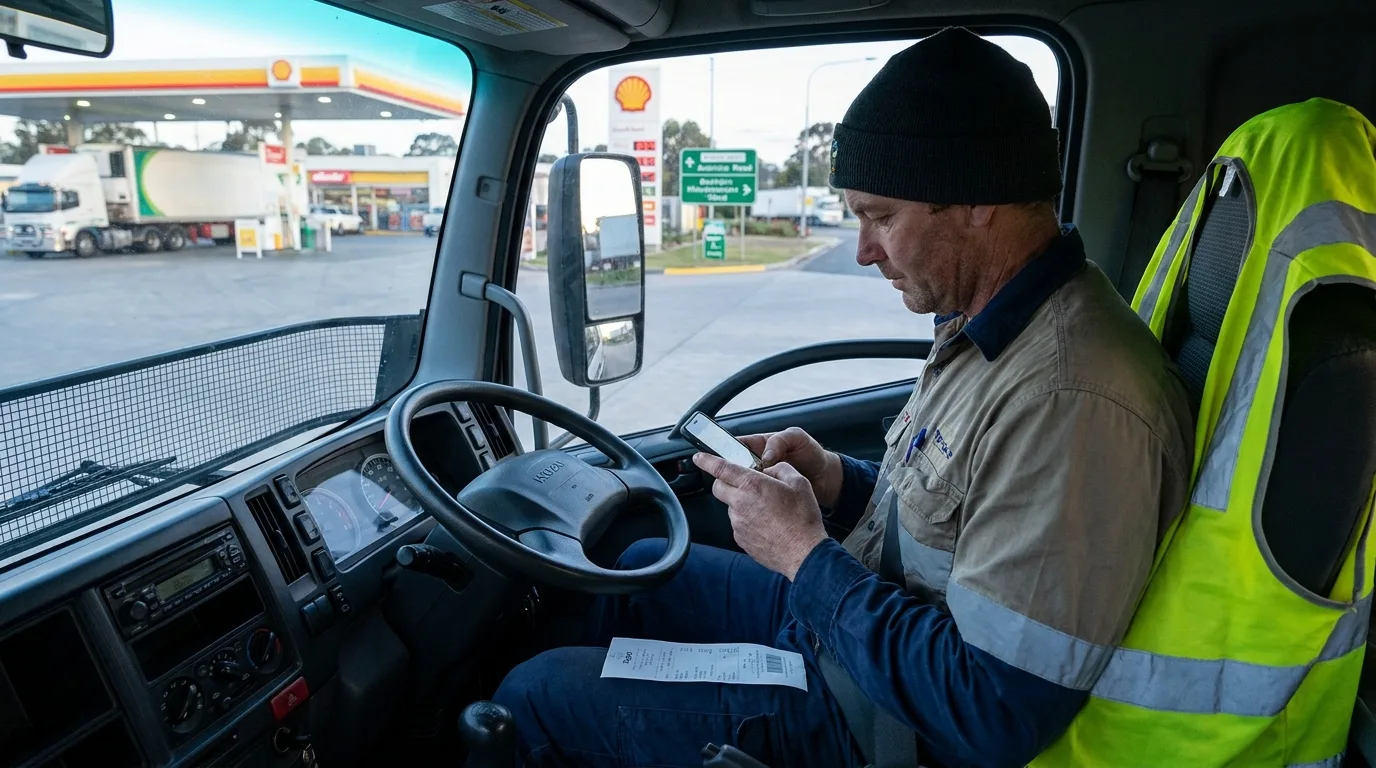
Your fleet of 15 vehicles consumed $12,000 in fuel last month. You know the total from the fuel card statement. What you do not know is which routes are costing more than they should, which drivers are filling up more frequently than expected, or whether the $800 in “miscellaneous” charges were legitimate maintenance or personal purchases.
Transport and logistics companies run on tight margins where fuel is the largest variable cost. When fleet expenses flow through fuel cards with monthly statements, shared bank cards for maintenance, and driver reimbursements for tolls and parking, the finance team has zero real-time visibility into the cost of moving goods.
Why expense management breaks down in transport
Fuel cards provide totals but not intelligence. Traditional fuel cards tell you how much was spent at which station. They do not tell you cost per kilometre, cost per route, or whether a driver’s fuel consumption is trending above the fleet average. The data arrives monthly with no actionable insight.
Maintenance and repair costs are invisible until the statement. Drivers get tyres replaced, oil changed, and minor repairs done on the road. These purchases go on the shared card or get reimbursed later. The finance team discovers the total maintenance cost at month-end, too late to question or control.
Tolls, parking, and incidentals create reimbursement backlogs. Drivers pay tolls, parking fees, and occasional meals out of pocket. They submit claims when they remember, which might be fortnightly or monthly. The finance team processes a backlog of stale claims with incomplete documentation.
Multiple depots and subcontractors blur cost attribution. A transport company with three depots and a mix of employed drivers and subcontractors has no single view of fleet costs. Each depot manages its own expenses differently, and subcontractor costs arrive as invoices rather than real-time data.
What replaces the manual process
| Before | After |
|---|---|
| Fuel cards with monthly statements | Per-driver cards with real-time fuel tracking |
| Shared bank card for maintenance | Individual cards with maintenance budget limits |
| Driver reimbursements for tolls and parking | Card covers all fleet expenses, no out-of-pocket |
| No visibility until month-end | Real-time fleet cost data across every vehicle |
| Cost per route unknown | Per-driver, per-vehicle spend data for route costing |
| Manual reconciliation from multiple sources | Automatic sync to Xero with vehicle codes attached |
How it works in practice
Per-driver budgets with fleet attribution. Each driver gets their own Visa debit card with limits for fuel, maintenance, tolls, and incidentals. Every transaction is attributed to the driver and their assigned vehicle. The finance team sees fleet costs in real time, per vehicle and per route.
One card replaces fuel cards, maintenance cards, and reimbursements. Instead of managing three separate payment methods (fuel card, bank card, reimbursement claims), each driver has one card that covers everything. Simpler for the driver, simpler for the finance team.
Receipt capture from the cab. The mobile app prompts a receipt photo after each transaction. Buddy AI extracts the details and codes the transaction to the correct vehicle and cost category. Drivers spend 10 seconds on a receipt, not 10 minutes on a claim form.
Pre-transaction controls for maintenance. Routine maintenance (fuel, tolls, parking) flows through without approval. Larger maintenance purchases (tyres, repairs above $500) route to the fleet manager for approval before the card authorises. This prevents surprise repair bills while keeping routine operations frictionless.
Results from transport businesses
Transport and logistics companies that replace fragmented payment methods with individual driver cards report immediate improvements in visibility and cost control.
The pattern across fleet-based businesses is consistent: when every transaction is attributed to a specific driver and vehicle in real time, fuel anomalies surface within days rather than months. Drivers who know their spending is visible tend to be more conscious of costs. And the finance team eliminates the monthly reconciliation of fuel card statements, bank statements, and reimbursement claims into a single source of truth.
For a transport company running 15 vehicles, the administrative time saved on reconciliation alone typically exceeds 8-10 hours per month. The cost intelligence gained from per-driver, per-vehicle data enables route optimisation decisions that were previously impossible.
Getting started
Most transport companies complete the transition within 14 days:
- Set up per-driver budgets with fuel, maintenance, and incidental limits
- Issue individual Visa debit cards to all drivers
- Brief the team on the card and receipt capture app (10 minutes)
- Connect to Xero for automatic transaction sync
- Cancel fuel cards and stop the reimbursement process
For the full transport feature set, visit the transport expense management solution page. To see how fleet budgets work, watch the demo. For a broader market view, see our comparison of the 5 best expense management software for Australian SMEs.