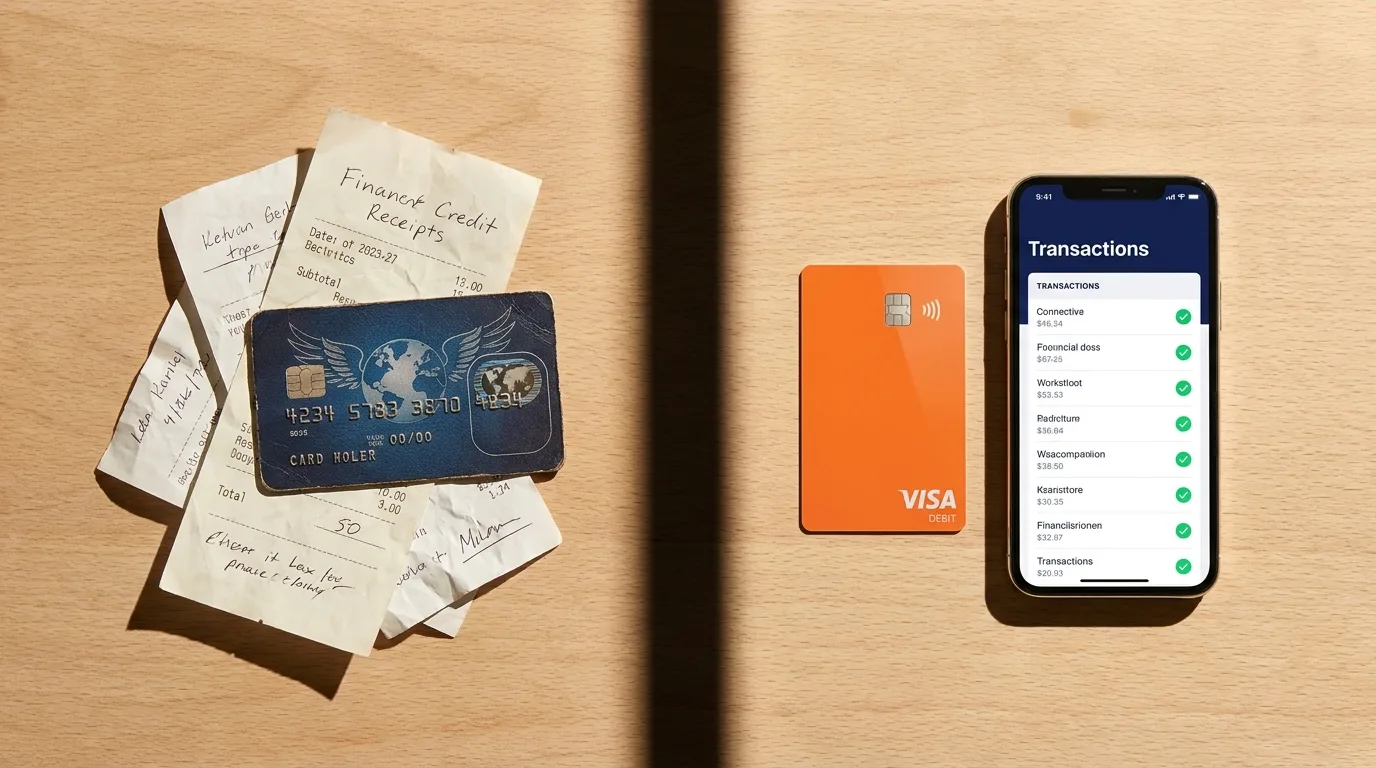


Five people share one company credit card. Nobody knows who bought what. The statement arrives 30 days later and your finance manager spends a full day matching transactions to people, projects, and receipts. Half the receipts are missing. Two charges look suspicious but nobody remembers them.
This is the shared card problem. It affects nearly every Australian SME that hasn’t moved to individual corporate cards. And it’s costing more than most business owners realise.
Corporate cards for small business aren’t just a convenience upgrade. They’re a structural change in how money moves through your organisation. Individual cards with pre-approved budgets replace the chaos of shared cards, personal card reimbursements, and petty cash with a system that provides control and trust simultaneously.
Here’s why Australian SMEs are making the switch, and why debit corporate cards are winning over traditional credit cards.
Credit Card vs Corporate Debit Card: The Structural Difference
Before diving into benefits, it’s worth understanding why the type of corporate card matters.
| Feature | Traditional Credit Card | Corporate Debit Card (Budgetly) |
|---|---|---|
| Funding | Credit line (borrowed money) | Pre-loaded from business account |
| Liability | Business liable for full balance | Can only spend what’s allocated |
| Overspend risk | High (credit limit shared across users) | Zero (card stops at budget limit) |
| Interest charges | Yes, if balance carried | None (it’s your own money) |
| Interchange cap from 1 Oct 2026 | 0.80% (commercial credit) | 8c + 0.16% (domestic debit) |
| Credit check | Required | Not required |
| Issuance speed | Days to weeks | 30 seconds (virtual), days (physical) |
| Individual cards | Often limited to senior staff | Every team member gets their own |
| Real-time visibility | Statement arrives monthly | Every transaction visible instantly |
| Budget controls | Shared limit, no per-person control | Individual budgets per card |
The RBA’s surcharge reforms sharpen this comparison. From 1 October 2026 surcharging ends on both card types, so the interchange gap gets absorbed rather than passed on. See what the surcharge ban changes for business cards.
1. Eliminate Reimbursements Entirely
Corporate cards eliminate reimbursements by giving every employee their own card to spend within a pre-approved budget, so no personal money is ever fronted and no claim forms are ever filed.
Reimbursements are broken by design. An employee pays out of pocket. They submit a claim days or weeks later. Finance processes it. The employee waits another pay cycle to get their money back.
This creates friction at every step. Employees resent paying for business expenses with personal funds. Finance teams waste hours processing claims. Late submissions delay month-end close.
Corporate cards eliminate this workflow completely. Every team member gets their own card. They spend within their approved budget. No personal money involved. No claim forms. No processing queue.
Bawinanga Aboriginal Corporation had staff across remote locations submitting reimbursement claims weeks after purchases. After switching to individual corporate cards, they recovered 38 hours per week. That’s the equivalent of a full-time salary redirected from admin to actual work.
2. Real-Time Spend Visibility
Individual corporate cards show every transaction on a dashboard the moment it happens, rather than on a monthly statement 30 days later.
With a shared credit card, you don’t know what’s been spent until the statement arrives. That’s 30 days of blind spots. Budget blowouts only become visible after the money is gone.
Individual corporate cards with real-time tracking change this completely. Every transaction appears on your dashboard the moment it happens. You see who spent what, where, and against which budget.
This isn’t just reporting. It’s real-time spend control. Finance teams can spot unusual patterns immediately. Budget owners see their remaining allocation in real time. There are no month-end surprises because nothing is hidden for 30 days.
For business owners, this means knowing where the money’s going without micromanaging. You set the budgets. The system enforces them. You check the dashboard when you want to, not because you have to.
3. Pre-Approved Budgets Replace Approval Chains
Set the budget once, upfront. After that, staff spend freely within their allocation without asking permission, because the card enforces the limit automatically.
Traditional expense management relies on approval chains. Someone needs to buy something. They email their manager. The manager forwards to finance. Finance checks the budget. Three days pass. The purchase happens (or doesn’t).
Corporate cards with pre-approved budgets invert this model. The approval happens once, upfront, when the budget is set. After that, staff spend freely within their allocation. No permission slips. No email chains. No delays.
This is the trust equation that matters: autonomy for your team, control for finance. Both are true at the same time.
The budget is the limit. When it runs out, the card stops working. No overdraft. No overspend. No awkward conversations.
4. Faster Month-End Reconciliation
Corporate cards with automated receipt matching and auto-categorisation reduce month-end close from days to hours, because every transaction is coded and receipted at the point of purchase, not chased weeks later.
Month-end close is where manual expense processes collapse. Finance teams spend days matching transactions to receipts, chasing missing documentation, and manually coding entries into Xero or MYOB.
Corporate cards with automated receipt matching and auto-categorisation reduce this to hours. Every transaction is coded at point of purchase. Receipts are captured in real time. Data syncs to your accounting software automatically.
Budgetly customers report 75% faster month-end reconciliation (based on customer-reported outcomes across 82 case studies). That’s not a marginal improvement. It’s the difference between a three-day close and a same-day close.
Killara Hospitality Services saw an 80% reduction in time spent on expense administration after switching to individual corporate cards with automated workflows.
5. Accountability Without Micromanagement
Individual cards give every transaction exactly one owner, so accountability is structural rather than something finance has to enforce after the fact.
Shared cards destroy accountability. When five people use one card, nobody owns any transaction. Disputes become “I thought you bought that” conversations. Missing receipts have no clear owner.
Individual corporate cards solve this structurally. Every transaction has one owner. Every card connects to one person and one budget. There’s no ambiguity about who spent what.
This creates accountability without surveillance. You’re not checking up on people. The system records everything automatically. Staff know their spending is visible, which naturally reduces unnecessary purchases. Finance reviews exceptions, not every transaction.
6. Reduced Fraud and Overspend Risk
Each card has its own spending limit, merchant restrictions, and real-time alerts, so a single compromised card doesn’t expose the entire business’s funds.
Credit cards with shared access are a fraud risk. If one person misuses the card, the entire credit line is exposed. Detecting misuse takes weeks because the statement arrives monthly.
Corporate debit cards reduce this risk structurally:
- Each card has its own spending limit (not a shared credit line)
- Merchant category restrictions block spending at unapproved vendors
- Real-time alerts flag unusual transactions immediately
- Cards can be frozen or cancelled in seconds from the admin dashboard
- No credit line means no debt accumulation from misuse
Connecting Families saved $21,000+ after switching from a traditional credit card setup to individual corporate debit cards. The savings came from eliminated fees, reduced overspending, and recovered staff time that was previously spent on manual controls.
7. Employee Experience That Actually Works
Individual cards mean employees are never out of pocket. They see their budget on their phone, spend within limits without asking permission, and never fill out a reimbursement form.
Corporate cards aren’t just a finance tool. They’re an employee experience decision.
Staff who use personal cards for business expenses feel untrusted. They’re lending the company money interest-free. They wait weeks for reimbursement. They fill out forms that feel like asking for pocket money.
Individual corporate cards flip this dynamic. Every team member gets their own Visa card. They see their budget in real time on their phone. They spend within limits without asking permission. They’re never out of pocket.
This matters for retention. Staff prefer working at companies that don’t make them front business expenses. It’s a small thing that signals trust. Across 20,000+ users, Budgetly maintains 99% customer retention. Part of that is the finance team experience. Part of it is that employees actually like using the system.
The RBA Surcharge Context: Why Debit Is Winning
The Reserve Bank of Australia’s surcharge reforms are reshaping how businesses think about card payments. From 1 October 2026, merchants can no longer surcharge eftpos, Mastercard or Visa payments on either debit or credit, and new interchange caps apply.
For businesses issuing corporate cards, this means:
- Commercial credit interchange is capped at 0.80% of transaction value, against 8 cents plus 0.16% for domestic debit
- With no surcharge available, whoever accepts the payment absorbs that difference
- Issuers funded rewards programs partly from interchange, so points and fee structures are being repriced
Corporate debit cards were already cheaper to run: no interest, no annual card fee, no credit check to issue. What the reform changes is that the compensating argument for credit, the rewards, is getting weaker.
Read more about what the RBA surcharge ban changes for business cards.
What a Bank Card Requires That a Corporate Debit Card Doesn’t
Most business credit cards require a turnover of around $75,000 annually, a personal guarantee from the business owner, and interest of around 20% p.a. on any balance carried (based on published rates from the four major Australian banks as of August 2026). Card fees add up separately, typically $150 per card at a minimum and up to $1,750 a year for premium cards.
The personal guarantee is worth understanding, because it changes who’s actually on the hook. A card issued under a personal guarantee makes the business owner personally liable for any outstanding debt, not just the business entity. If the business can’t pay, the bank comes after the owner directly.
None of this applies to a debit-based corporate card, because there’s no debt being extended. You’re spending funds the business already holds, so there’s nothing to guarantee and nothing to carry a balance on.
“I can now set a cap on my company spending. For example, previously, staff would tell me that they would spend $400 on equipment, but now I can set how much they should spend on equipment, and I can even set this for each school term. So that’s handy.”
Judy O’Leary, Hillsborough OOSH
Proof: Results From Australian SMEs
The benefits above aren’t theoretical. Here’s what Australian organisations report after switching to corporate cards with Budgetly.
- Bawinanga Aboriginal Corporation: 38 hours/week saved by eliminating reimbursements across distributed teams
- Killara Hospitality Services: 80% reduction in expense administration time
- Connecting Families: $21,000+ saved in the first year
- Earth Markets: 30 hours/month saved across multiple retail locations
Across the Budgetly customer base: $1.5B+ in payment volume processed, 20,000+ users, 99% customer retention, and a 4.9/5 rating on Capterra from 132 verified reviews.
Frequently Asked Questions
Do corporate cards require a credit check?
Can I set different spending limits for different employees?
What happens if an employee leaves the company?
How do corporate cards work with Xero?
Are corporate debit cards safe for online purchases?
Ready to give every team member their own card with built-in limits? See how it works. Cards issued in 30 seconds. Controlled in real time. No credit check required.