

A cash flow forecast is a projection of the money coming into and going out of your business over a set period, usually week by week or month by month, so you can see when cash will run short before it happens. You build one by starting with your opening bank balance, adding expected cash in, subtracting expected cash out, and rolling the closing balance into the next period. This guide shows you how to do it, with an Australian worked example, and a free template you can download.
Most cash flow advice stops at “keep an eye on your cash.” That is not a method. Below is the actual method Australian small businesses use, the line items that catch AU businesses out (GST, BAS, PAYG, super), and an honest look at what a forecast can and cannot do for you.
What is a cash flow forecast?
A cash flow forecast estimates your future cash position. It answers one question: will there be enough money in the bank to cover what is due, and if not, when does the gap appear?
It tracks cash movement, not profit. A profitable business can still run out of cash if customers pay late and a big tax bill lands the same week. The forecast is the tool that shows you that collision before it happens, while you still have time to act.
Three things a cash flow forecast is not:
- Not a cash flow statement. A cash flow statement is a historical record of what already happened. A forecast looks forward.
- Not a profit forecast. Profit counts income when it is earned. Cash flow counts money when it actually moves.
- Not a budget. A budget is your fixed plan for the year; a forecast is a living estimate you update as reality changes. If you want the full distinction, see our guide on the difference between a budget and a forecast.
The cash flow forecast formula
Every cash flow forecast runs on one calculation, repeated for each period:
Closing balance = Opening balance + Total cash in − Total cash out
The closing balance of one period becomes the opening balance of the next. That is what makes it a forecast rather than a snapshot: it rolls forward, so a shortfall three months out shows up now.
How to forecast cash flow, step by step
You can build a cash flow forecast in a spreadsheet in under an hour. Here is the sequence.
1. Set your opening cash balance
Start with the real cash in your bank accounts today. Not your profit, not your accounts receivable, the actual bank balance. This is the only figure you take from reality; everything after it is an estimate.
2. Forecast your cash in
List every source of money coming in for each period:
- Customer receipts (what you expect to actually collect, not what you invoice, timing matters)
- GST you collect on sales
- Other income: grants, interest, tax refunds
- Any loans or capital going in
Be honest about timing. If a customer pays on 30-day terms, the cash lands next month, not this one. Late-paying customers are the single most common reason a forecast turns out wrong.
3. Forecast your cash out
List every payment leaving the business. For Australian SMEs, these are the ones that break forecasts because they are lumpy and easy to forget:
- Wages and salaries
- Superannuation guarantee
- PAYG withholding to the ATO
- PAYG instalments to the ATO
- The quarterly GST/BAS payment
- Rent and utilities
- Suppliers and inventory
- Software subscriptions
- Loan and finance repayments
4. Calculate net cash movement
For each period, subtract total cash out from total cash in. A positive number means cash grew that period. A negative number means it shrank, which is fine as long as the closing balance stays above zero.
5. Roll the closing balance forward
Add net movement to the opening balance. That gives your closing balance. Carry it into the next period as the new opening balance, and repeat. When a closing balance goes negative, you have found your shortfall, and the month you need to act before.
A cash flow forecast example (Australian business)
Here is a simplified three-month example for a services business on quarterly BAS. Figures are illustrative.
| Line item | Month 1 | Month 2 | Month 3 |
|---|---|---|---|
| Opening balance | $40,000 | $46,000 | $39,000 |
| Customer receipts (incl. GST) | $88,000 | $80,000 | $92,000 |
| Total cash in | $88,000 | $80,000 | $92,000 |
| Wages and super | $52,000 | $52,000 | $52,000 |
| PAYG withholding | $9,000 | $9,000 | $9,000 |
| GST/BAS payment (quarter) | $0 | $0 | $18,000 |
| Rent, suppliers, other | $21,000 | $26,000 | $22,000 |
| Total cash out | $82,000 | $87,000 | $101,000 |
| Net cash movement | $6,000 | −$7,000 | −$9,000 |
| Closing balance | $46,000 | $39,000 | $30,000 |
The business is profitable across the quarter, but notice Month 3: the quarterly BAS payment of $18,000 lands on top of normal costs and cash drops by $9,000 in a single month. Spot that in advance and you can move the payment date planning forward, chase receivables early, or hold a discretionary purchase. Spot it when the payment bounces and you have a problem. That is the entire point of forecasting.
You do not have to build this from scratch. Download our free cash flow forecast template, which is pre-built with these Australian line items and the formulas already in place.
Forecasting cash flow in Xero and MYOB
If you run Xero or MYOB, both offer a basic cash flow forecast built from your bank feed and scheduled bills. They are a reasonable starting point and pull your real data automatically.
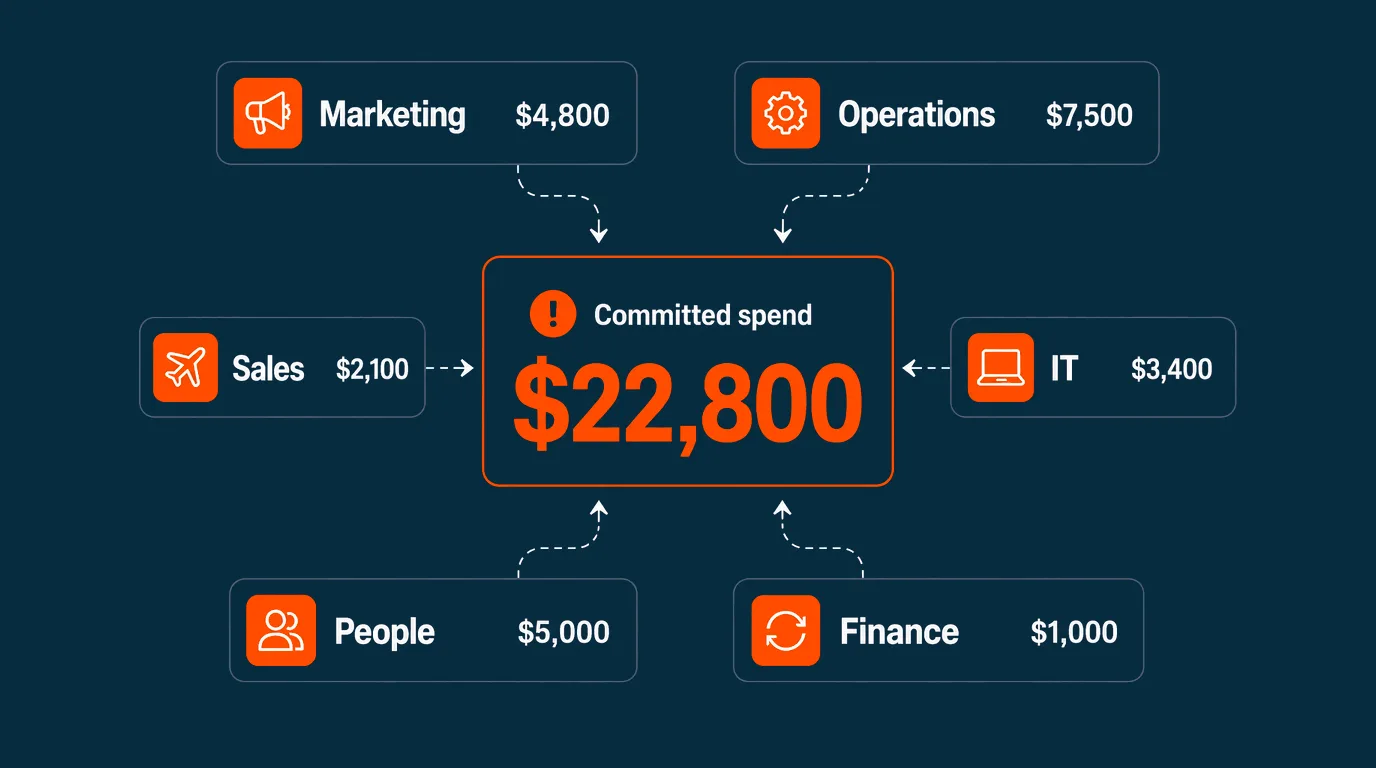
Their limit is the same as any forecasting tool: they project the future from what has already been entered. A bill that has not been raised yet, or a discretionary purchase a team is about to make, is invisible to the forecast until after the money moves. The forecast is only as accurate as the spending it can see. That gap between the plan and what teams actually spend is the reason forecasts drift, and it is the half a bank feed cannot close.
Why cash flow forecasts go wrong (and what a forecast can’t do)
A forecast predicts a shortfall. It does not prevent one.
The most common reasons a forecast turns out wrong are all about the outflow side: a team spends outside the plan, a subscription auto-renews that nobody logged, or a supplier run goes ahead that was not in the model. Your forecast never saw the money leave, so its projection was wrong from the moment you built it.
This is the honest limit of forecasting. A spreadsheet has no control over what leaves your bank account between updates. It watches; it does not stop anything.
Closing that gap is what Budgetly does. Every employee gets a Visa debit card tied to a pre-approved budget. Spending is enforced at the point of purchase, the card declines when the budget is gone, and every transaction is categorised and synced to Xero or MYOB in real time. The forecast tells you the plan. Real-time spend control keeps reality matching it. If your revenue is lumpy, a tighter 13-week rolling cash flow forecast paired with enforced budgets is the combination that actually holds.