
You are comparing business credit cards right now because the rewards look good on paper. One card offers 1.25 points per dollar. Another promises 1% cashback. But while you are reading the fine print on annual fees and earn rates, $3,000 in untracked spend went through the shared company card last month and nobody noticed until the statement arrived.
That is the actual cost most Australian SMEs carry. Not the $250 annual fee. Not the interest rate. The invisible leakage that rewards can never offset.
This guide compares business rewards cards and business expense cards side by side. Not just features, but the financial outcomes that matter when you have 10, 20, or 50 people spending company money.
The Real Cost of Rewards Cards (It’s Not the Annual Fee)
The maths on rewards cards sounds compelling at first glance. A business spending $50,000 per month on a 1% cashback card earns $500 back. A points card might yield $300-$500 in flight credits. Over a year, that is $3,600-$6,000 in value.
Here is what rarely makes it into the comparison spreadsheet.
The hidden costs of uncontrolled business spend:
- Duplicate purchases: Two team members buying the same software subscription because nobody can see what has already been purchased. Average cost: 2-4% of total spend.
- Over-budget spending: No per-person limits means the card gets used for anything until someone checks the statement weeks later.
- Missing receipts: The ATO requires receipts for GST credits on purchases over $82.50. Every missing receipt is a lost GST credit worth 1/11th of the purchase price.
- Late reconciliation: When statements arrive 2-4 weeks after spend, errors are harder to catch and harder to dispute.
- Personal purchases on company cards: Without real-time visibility, these go unnoticed for weeks.
Industry data shows uncontrolled business spend leaks between 3% and 8% of total card spend through these channels. On $50,000 monthly spend, that is $1,500 to $4,000 per month in waste.
Your 1% cashback card earns $500. Your lack of controls loses $1,500 to $4,000. The net position is negative every single month.
The rewards do not cover the waste. They never did. The comparison was always between earning points and eliminating leakage, and eliminating leakage wins by a factor of three to eight.
Business Expense Cards vs Credit Cards: Feature Comparison
The structural differences between business rewards cards and business expense cards go beyond points versus no points. They represent fundamentally different approaches to how your team spends money.
| Feature | Business Rewards Card | Business Expense Card |
|---|---|---|
| Rewards/Points | Yes (0.5-1.25% return) | No |
| Per-person spending limits | No (shared credit limit) | Yes (individual pre-approved budgets) |
| Real-time transaction visibility | No (statement-based, 2-4 week delay) | Yes (instant notifications and dashboard) |
| Automatic receipt capture | No (manual collection required) | Yes (app-based photo capture at point of sale) |
| Accounting integration | Manual CSV upload or basic feeds | Automatic Xero/MYOB sync with categorisation |
| Card issuance speed | 5-10 business days (postal delivery) | Instant virtual cards, 3-5 days physical |
| Number of cardholders | Limited (credit assessment per card) | Unlimited (no individual credit checks) |
| Personal guarantee required | Yes (director guarantee typical) | No |
| Merchant category controls | No | Yes (block specific merchant types) |
| GST handling | Manual at reconciliation | Automatic extraction from receipts |
| Monthly reconciliation time | 4-8 hours for 20 cardholders | Under 1 hour (automated matching) |
| Liability model | Joint and several (directors liable) | Pre-loaded funds (no debt, no liability) |
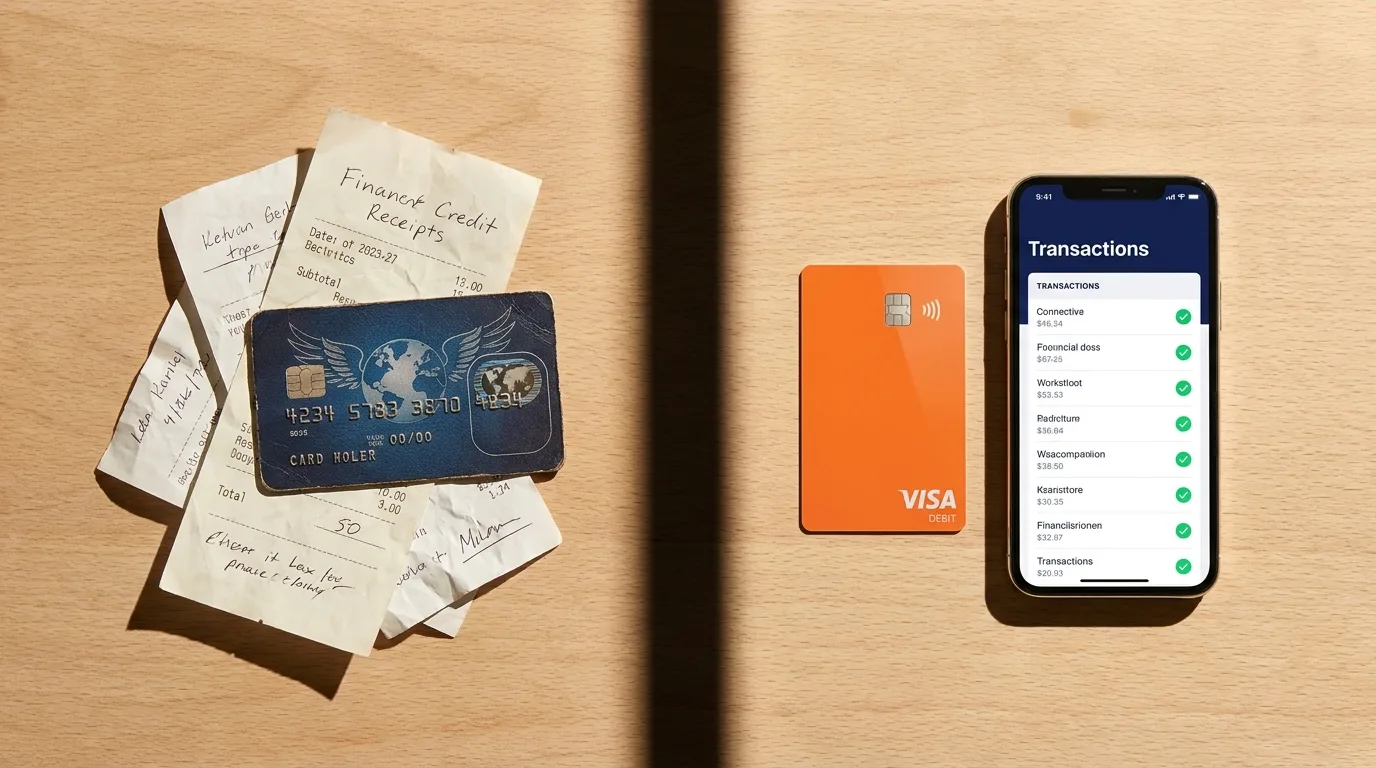
The pattern is clear. Rewards cards optimise for the person doing the spending. Expense cards optimise for the person managing the spending.
If you are a sole trader with one card, rewards make sense. If you are running a team of 10-50 people who all need to purchase things, the control gap in rewards cards costs you far more than the rewards earn.
What expense cards replace
Business expense cards do not just replace the credit card itself. They replace the entire reconciliation workflow around it:
- The shared spreadsheet tracking who has the card this week
- The monthly email asking everyone to submit receipts
- The 6-hour reconciliation session matching statements to approvals
- The awkward conversation about the $180 charge nobody claims
- The manual reimbursement process for staff who paid out of pocket
When Rewards Cards Make Sense (and When They Don’t)
To be fair, there are scenarios where a business rewards card remains the right choice.
Rewards cards work well when:
- A single person (owner or finance manager) controls all spending
- Monthly spend exceeds $100,000 and is concentrated in travel
- The business has robust manual processes for receipt collection
- Points redemption is strategic (business class flights for client meetings)
- The business already has separate controls in place for other staff spend
Rewards cards break down when:
- Multiple team members need purchasing power (10+ cardholders)
- Spend is varied (fuel, supplies, subscriptions, travel, client entertainment)
- The finance team spends hours each month chasing receipts
- GST credits are being lost due to missing documentation
- Staff are using personal cards and submitting reimbursement claims
- Nobody knows the total spend position until the statement arrives
For most Australian SMEs with teams of 20-200 people, the second list describes their reality. The promise of points keeps them on rewards cards, but the operational cost of that choice compounds every month.
The businesses searching for the best business rewards card in Australia are often solving the wrong problem. The question is not “which card earns the most points?” It is “which card system gives me visibility and control over what my team is spending?”
The RBA Surcharge Ban: Why Debit Beats Credit in 2026
From 1 October 2026, the Reserve Bank of Australia’s surcharge reforms change the economics of business cards. Merchants will no longer be able to pass card surcharges to customers at the point of sale, on debit or credit. The interchange fees don’t disappear. They get absorbed into the cost base instead.
Here is what this means for businesses choosing between card types:
Commercial credit cards are capped at 0.80% of transaction value in interchange from 1 October 2026. Domestic debit and prepaid cards are capped at 8 cents plus 0.16%. Those costs don’t disappear when surcharging ends. They land on whoever accepts the payment.
A business taking $600,000 a year in card payments faces roughly $4,800 in interchange if all of it arrives on commercial credit, against about $960 on domestic debit. From 1 October there’s no surcharge available to offset the difference.
One distinction worth holding onto: interchange is borne by the business accepting a payment, not the business spending on the card. If you’re choosing which card to issue your own team, the costs that matter are interest, annual fees, and rewards programs that issuers are now cutting back.
For the full picture, read what the RBA surcharge ban changes for business cards.
Business expense cards built on debit rails (like Budgetly’s Visa cards) benefit from this structural advantage without requiring any action from the cardholder. The savings are built into every transaction.
What $21,000 in Savings Actually Looks Like
The comparison between rewards and control is not theoretical. Australian businesses have made this switch and measured the results.
Connecting Families: $21,000+ saved annually
Connecting Families was using a combination of bank credit cards, fuel cards, and voucher systems across their team. The rewards points looked good on paper, but the operational overhead was enormous.
After switching to expense cards with pre-approved limits and real-time visibility, they identified and eliminated $21,000 in annual waste. That is not revenue. That is pure savings from removing duplicate purchases, catching overspend in real time, and eliminating the reconciliation burden.
No rewards program in Australia returns $21,000 on an SME’s spend volume. Control beat points by an order of magnitude.
Killara Hospitality: 80% time reduction in reconciliation
Killara Hospitality was running manual reimbursements combined with individual bank cards for their team. Their finance manager spent days each month matching receipts to statements, following up on missing documentation, and reconciling across multiple card accounts.
After switching to a unified expense card platform, reconciliation time dropped by 80%. The hours freed up went back into strategic finance work instead of administrative chasing.
Faith Christian School: One week per month saved
Faith Christian School was using bank credit cards with a 2-4 week wait between transactions occurring and statements arriving. During that gap, spend was invisible. Budget tracking was reactive, not proactive.
After switching, they recovered one full week per month previously consumed by manual card administration. Their finance team now sees every transaction in real time and spends minutes, not days, on monthly close.
The common pattern
Every one of these organisations was using rewards-earning bank cards before switching. Every one of them found that the savings from control exceeded the rewards they gave up. The typical ratio is 5:1 to 10:1 in favour of control-based savings over rewards earnings.
Making the Switch: What to Consider
If you are currently on business rewards cards and considering expense cards, here is what the transition looks like:
Calculate your true rewards value. Take your annual points/cashback earnings and express them as a dollar figure. For most SMEs, it is $2,000-$8,000 per year.
Estimate your control gap. How many hours does reconciliation take? How many receipts go missing? How often does unexpected spend appear on statements? Even conservative estimates typically show 3-5% leakage.
Compare the net position. If you spend $500,000 annually and earn 1% back ($5,000), but lose 4% to uncontrolled spend ($20,000), switching to expense cards saves you $15,000 net.
Factor in time savings. At $80/hour for a finance professional, saving 6 hours per month on reconciliation is worth $5,760 annually. Add receipt chasing (3-5 hours/month) and reimbursement processing (2-4 hours/month) and the labour saving alone can exceed $15,000 per year for a team of 30+.
Assess the transition effort. Most businesses switch in one day. Virtual cards are issued instantly. Physical cards arrive within 3-5 business days. No credit checks or personal guarantees required. Your team downloads the app, activates their card, and starts using it immediately. The longest part is not the technology; it’s communicating the change to your team. Budget 30 minutes for that conversation.
Plan the overlap. Keep existing credit cards active for 30 days while the new system beds in. Cancel once you have confirmed all recurring subscriptions are transferred and the finance team has verified Xero reconciliation is working automatically.
The businesses that benefit most from expense cards are those with distributed teams, varied spend categories, and finance staff whose time is better spent on strategic work than receipt chasing.
What CFOs Report After Switching from Credit to Expense Cards
The conversation shifts within the first month. Finance leaders who made the switch consistently report three changes that weren’t in their original business case:
Board reporting gets simpler. With real-time visibility across every budget and team, monthly board packs pull from live data rather than reconstructed spreadsheets. The CFO presents actuals from the system, not estimates cobbled together from late statements. Board members ask fewer “what happened?” questions because the data arrives with context attached.
Employee relationships improve. The shared credit card was a source of friction. Who spent what? Why did Marketing exceed their allocation? Under expense cards with individual accountability, these conversations disappear. Each person owns their budget. Spending is transparent. Trust replaces suspicion because the system provides visibility without requiring interrogation.
Audit preparation becomes trivial. When every transaction has a receipt, a category, and an approver attached from day one, end-of-year audit preparation is a matter of exporting the data. No more scrambling to reconstruct twelve months of undocumented transactions. ATO substantiation requirements are met automatically, not retrospectively.
Month-end close compresses. The typical 3 to 5 day close drops to hours. Transactions arrive coded. Receipts are attached. Reconciliation against Xero is automatic. The bookkeeper reviews exceptions rather than entering data line by line. For businesses running on Xero, this is the single biggest time saving.
These outcomes compound. First-month savings are visible. Third-month savings are structural. By month six, the finance team cannot imagine going back to a credit card model because the workflow no longer exists.