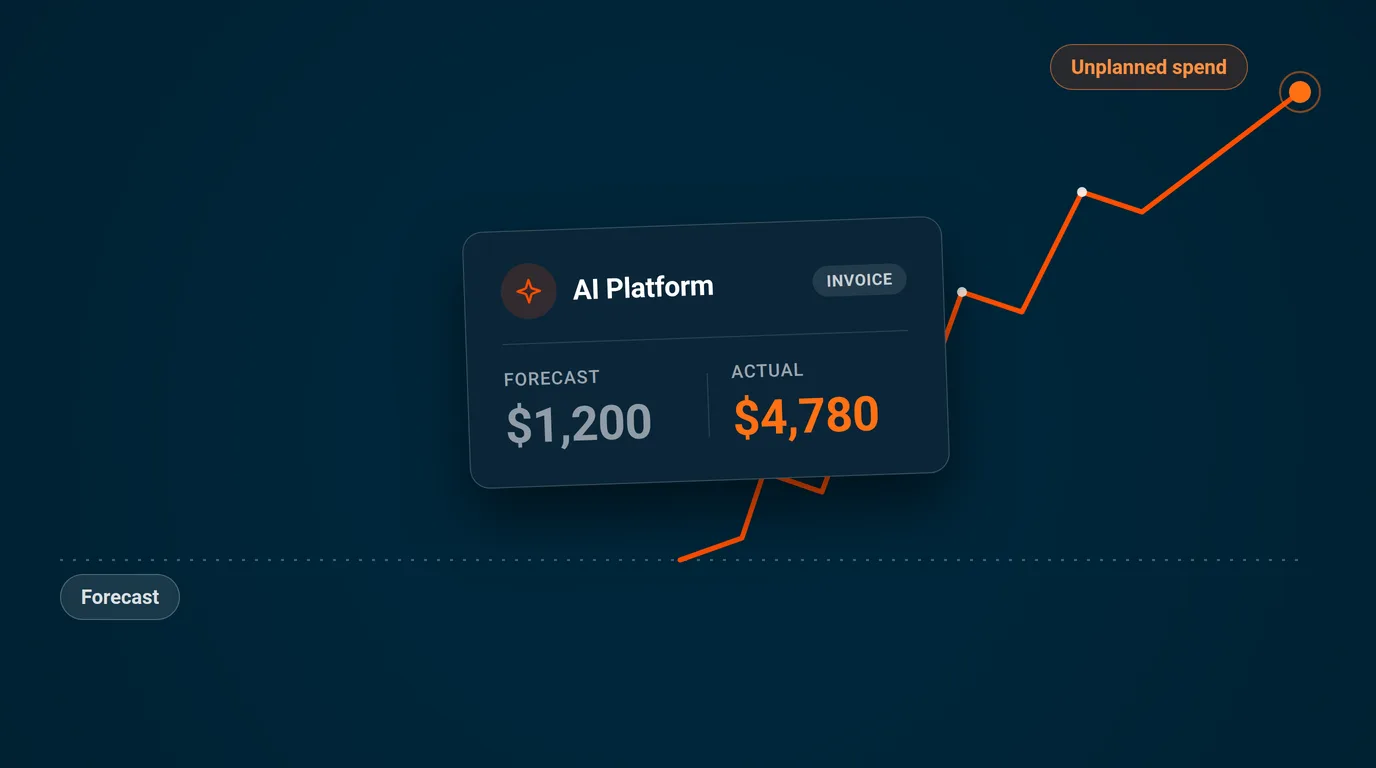

AI costs are becoming the new small spend leak, except the unit economics are harder to see and the variance is larger.
FinOps teams are signalling the shift clearly. AI cost management is now the single most sought after skill, with 58% prioritising it for development over the next 12 months. The share of FinOps teams managing AI spend rose from 31% in 2024 to 98% in 2026. Source: The Source Code.
That is the tell. The problem is not that AI is expensive. The problem is that AI is usage based, token based, and often distributed. If you wait for the invoice to understand what happened, you are already late.
This is the same spend control principle CFOs already know. Control before the spend happens, not after.
Why AI bills feel like a surprise
Traditional software costs are usually seat based. You can model them easily. Ten seats costs X. Fifty seats costs five times X. The invoice is predictable.
Token based AI behaves differently. Cost is driven by how often a feature is used, how long the prompts are, how large the responses are, which model is selected, and whether the experience retries or chains multiple calls behind the scenes.
It also fragments quickly. Inference can show up in vendor invoices, employee reimbursements for tools, and API keys created by different teams that never reconcile back to a single dashboard. This is a real finance concern, and it is exactly why visibility needs to be centralised rather than scattered across cards and vendors.
When cost is fragmented, nobody owns the number. When nobody owns the number, it blows out.
Build an AI spend control loop before launch
Treat AI cost like any other budget commitment. The time to manage it is before rollout.
Here is a practical control loop that keeps speed while avoiding surprises.
1. Set a per feature cost ceiling before launch
Do this at the feature level, not at the vendor level. “AI assistant” is not a budget category. “Summarise a call in the CRM” or “Generate a customer email draft” is. Define a ceiling per use, per day, or per workflow. If the ceiling is exceeded, the feature degrades gracefully, queues, or prompts for approval.
2. Require token visibility at the point of use
Monthly reconciliation from an invoice is a lagging indicator. It tells you what happened, not what is happening. The control loop needs instrumentation that shows token consumption by feature, by team, and by environment. If you cannot tie usage to a budget owner, you cannot manage variance.
3. Approve with a modelled worst case cost, not just a best case one
Every AI feature has a best case. Low usage, short prompts, small responses. It also has a worst case. High usage, long prompts, heavy context, retries, and power users who push the system hard. Treat the rollout like a commitment. Model worst case at launch, and decide if that worst case is acceptable. If it is not, redesign before release.
4. Centralise ownership of AI spend
AI spend should not be a set of disconnected subscriptions and API keys. Give one owner responsibility for the number, with clear escalation paths. Centralise the dashboards, the policies, and the thresholds. Teams can still move fast inside guardrails, but the business retains control.
The CFO checklist before approving any AI tool or feature
Before you sign off, run three questions.
What is the cost per use, not per seat
If the vendor only talks seats, ask what drives usage cost and how it is metered.
What happens to that cost at ten times current usage
Assume adoption succeeds. Assume it becomes core workflow. If usage multiplies, does the unit cost stay stable, or does the experience get more expensive as people rely on it more.
Who owns the number if it blows out
Name the budget owner. Confirm the dashboard. Confirm the ceiling. Confirm the response when the ceiling is hit.
AI can deliver real productivity gains. The finance risk is not the tool. It is uncontrolled usage without upstream visibility.
Build the control loop before the bill surprises you.