

In short: the best Airwallex alternative for an Australian SME depends on what you actually use it for. Airwallex is a global payments and multi-currency platform with expense management added on; Budgetly is a dedicated Australian spend-control platform, per-employee Visa cards, real-time budgets that prevent overspend, automatic receipt capture, and deep Xero/MYOB coding. If most of your spend is domestic AUD, a dedicated tool like Budgetly gives you control and accounting depth Airwallex’s expense module doesn’t. If you regularly pay overseas suppliers or hold multiple currencies, keep Airwallex for that, and many businesses run both. This guide covers when to switch, when to keep Airwallex, and how the two compare feature by feature.
You signed up for Airwallex because someone on the team needed to pay an overseas supplier. Now you have a global payments platform with multi-currency accounts, FX hedging tools, and an expense module bolted on as an afterthought. Your finance team spends most of their time managing domestic card spend across 30 employees, not wiring money to Singapore.
If 80% or more of your transactions happen in AUD between Australian merchants, you are paying for complexity you do not use. This guide explains when an Airwallex alternative makes sense and what to look for in a dedicated spend management system built for Australian SME workflows.
When Airwallex works (and when it does not)
Airwallex works well for businesses that:
- Pay international suppliers regularly (weekly or more)
- Hold balances in multiple currencies
- Need interbank FX rates on high-volume cross-border transfers
- Operate entities in multiple countries
- Process international payroll
Airwallex is over-engineered for businesses that:
- Transact primarily in AUD with Australian merchants
- Need per-employee cards with real-time budget controls
- Want deep Xero or MYOB integration (Chart of Accounts mapping, tracking categories, receipt attachment)
- Prioritise receipt capture and month-end reconciliation speed
- Have 20 to 200 employees making domestic purchases daily
- Need Australian phone support during AEST business hours
The core issue is product focus. Airwallex built a global payments infrastructure and added expense management as a feature. The expense module exists to support international operations, not to replace your domestic spend workflows.
Feature comparison: Airwallex vs Budgetly
| Feature | Airwallex | Budgetly |
|---|---|---|
| Primary purpose | Global payments and FX | Domestic spend control |
| Card type | Visa (AUD and multi-currency) | Visa debit (AUD, prepaid) |
| Real-time budget controls | Limited (card-level limits only) | Yes (organisation-wide budgets, per-team, per-project) |
| Budget enforcement | Card declines at card limit | Card declines at budget exhaustion |
| AI transaction coding | No | Yes (95%+ accuracy, improves over time) |
| Receipt capture | Basic (manual upload) | Automatic (push notification + OCR matching) |
| Xero integration depth | Basic bank feed | Deep (Chart of Accounts, tracking categories, receipts attached, GST coded) |
| MYOB integration | No | Yes |
| Bill payments | Yes (international focus) | Yes (domestic, with duplicate detection) |
| Approval workflows | Basic | Configurable (by amount, category, budget owner) |
| Multi-currency accounts | Yes (20+ currencies) | No (AUD only) |
| International transfers | Yes (interbank rates) | No |
| Australian support | Limited (primarily chat) | Yes (phone + email, AEST hours) |
| Pricing model | Transaction-based + FX spread | Flat monthly + $10/card |
| Credit check required | No | No |
| Setup time | 1-2 weeks | Same day |
| Published case studies | Limited (AU SME focus) | 82 with quantified outcomes |
The five gaps SMEs hit with Airwallex
1. No organisational budget controls
Airwallex lets you set limits on individual cards. But it does not let you create budgets that span departments, projects, or teams and automatically enforce spending across all cards within that budget.
With Budgetly, you create a “Marketing Q3” budget of $15,000, assign five team members to it, and the system tracks cumulative spend against that budget in real time. When the budget is 80% consumed, the budget owner gets an alert. When it is exhausted, all five cards decline. Finance never discovers overspend at month-end because the system prevented it.
This is the fundamental difference between card limits and budget controls. Card limits cap individual spending. Budget controls cap collective spending toward a specific purpose. An organisation with 30 employees needs both: individual limits so no single person overdraws, and budget-level controls so no department overdraws.
Budgetly provides both layers. Airwallex provides only card-level limits.
2. Shallow Xero integration
Airwallex’s Xero integration pushes transactions as basic bank feed entries. Your bookkeeper still needs to:
- Manually code each transaction to the correct account
- Verify GST treatment
- Apply tracking categories
- Attach receipts separately
- Reconcile the bank feed entry against the coded transaction
Budgetly’s Xero integration sends each transaction pre-coded with the correct Chart of Accounts entry, GST amount, tracking category, and receipt image attached. The bookkeeper reviews and approves rather than entering from scratch.
3. No AI-powered receipt matching
Airwallex requires employees to manually upload receipts and match them to transactions. If a receipt is not uploaded, there is no automatic chase system. This means finance discovers missing receipts at month-end when they reconcile, not at the point of purchase when the employee still has the receipt in their hand.
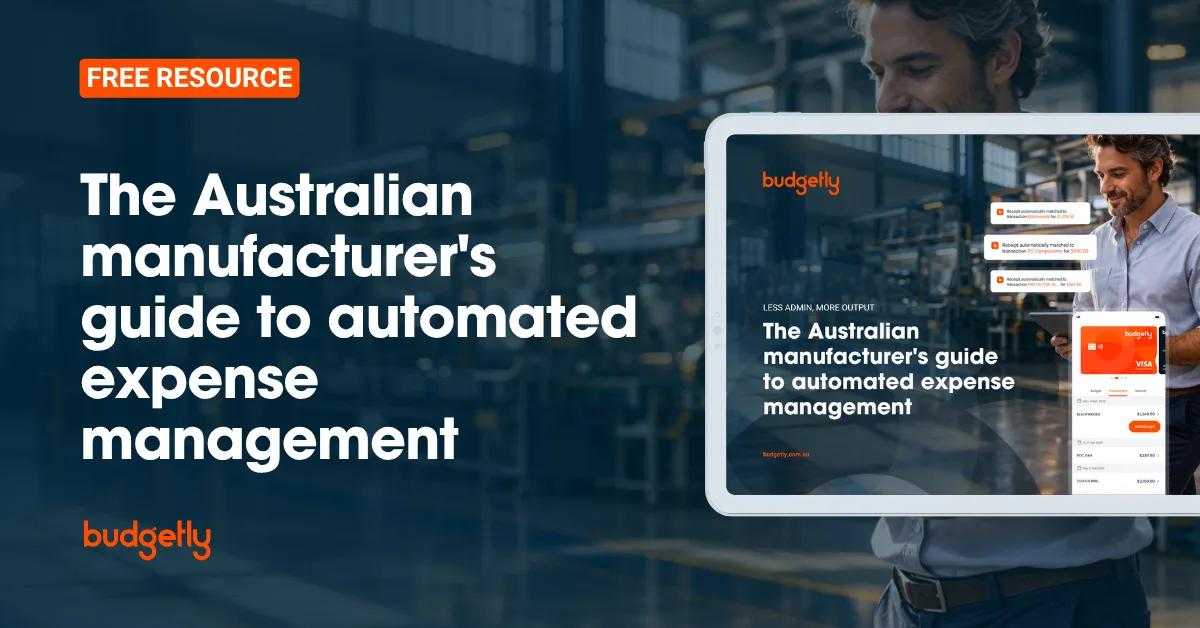
Budgetly sends a push notification the moment a card transaction occurs, prompting the employee to photograph the receipt. OCR reads the receipt, extracts the merchant, amount, GST, and line items, and auto-matches it to the transaction. If the employee does not capture within 48 hours, the system escalates to the budget owner. Receipt compliance is built into the workflow, not bolted on as an afterthought.
The ATO requires tax invoices for purchases over $82.50 to claim GST credits. Every missing receipt is a potential gap in your BAS claim. A system that captures receipts proactively at point of purchase eliminates this risk entirely.
4. Limited Australian support
Airwallex’s support is primarily via chat and email. Complex issues can take days to resolve. For Australian SMEs that need help during AEST business hours (not US or UK time zones), response times can be frustrating.
Budgetly provides Australian-based phone and email support during AEST business hours. The support team understands Australian tax obligations (GST, BAS), accounting standards, and the specific workflows of SMEs with 20 to 200 employees.
5. Pricing complexity
Airwallex’s pricing combines platform fees, transaction fees, and FX spreads. For businesses primarily making domestic AUD transactions, the FX capability adds zero value but the pricing structure inherits the complexity of a global platform.
Budgetly’s pricing is transparent: a flat monthly fee plus $10 per active card. Unlimited users. No per-transaction fees on domestic spend. No hidden FX markups on a currency you never use. You know exactly what you will pay before you sign up.
Who switches from Airwallex to Budgetly (and why)
The typical switching profile is an Australian SME that signed up for Airwallex to solve a specific international payment problem and then tried to use it for domestic expense management. They discover that a tool built for global payments infrastructure does not provide the granular spend control, receipt automation, and accounting integration depth that a 20 to 200 person Australian business needs for day-to-day expense management.
The pain compounds as the team grows. With 10 employees, you can manage card limits manually and chase receipts over Slack. With 50 employees making purchases across multiple departments, you need budgets that enforce themselves, receipts that capture automatically, and transactions that arrive in Xero already coded. Airwallex’s expense module was not built to scale that way because it was never the core product.
Specifically, these businesses discover:
- The expense module does not prevent overspend, only track it after the fact
- Receipt compliance is poor because there is no automated capture workflow
- Xero reconciliation still takes hours because transactions arrive without coding
- They are paying for multi-currency infrastructure they rarely use
- Support interactions are slow and the team does not understand their specific AU compliance needs
These businesses keep Airwallex for the 10-20% of their transactions that are genuinely international and move domestic spend management to a dedicated system.
Can you use both?
Yes. Many businesses run Airwallex for international payments and Budgetly for domestic spend control. The two do not compete because they solve different problems:
- Airwallex handles international supplier payments, multi-currency receivables, and FX conversion
- Budgetly handles employee cards, domestic purchases, receipt capture, budget enforcement, and Xero reconciliation
Both push transactions to Xero, giving your bookkeeper one unified view regardless of which system processed the payment.
This is not an unusual setup. The “best tool for each job” approach is how most growing SMEs end up structuring their finance stack. Xero handles accounting. A payroll system handles wages. Airwallex handles international payments. And a dedicated expense management system handles the cards, budgets, and receipt capture that control how money leaves the business domestically.
The cost of running both is typically lower than trying to force Airwallex to do domestic expense management well, because the hours saved on receipt chasing, manual Xero coding, and month-end reconciliation far exceed the Budgetly subscription cost.
What the switch looks like
Moving domestic expense management from Airwallex to Budgetly takes less than a day:
- Sign up for Budgetly (14-day free trial, no credit card required)
- Connect Xero and verify Chart of Accounts import (5 minutes)
- Create budgets by team, department, or project (30 minutes)
- Issue corporate cards to employees (instant virtual, physical in 3-5 days)
- Configure approval rules and receipt notification settings (15 minutes)
- Notify employees to use their new Budgetly cards for all domestic purchases
- Disable or restrict Airwallex cards for domestic use (keep active for international only)
Most businesses complete the transition within one business day and see the difference in their first month-end close.
Real results from businesses that made the switch
Australian SMEs that move domestic spend to a dedicated control system consistently report the same outcomes:
Bawinanga Aboriginal Corporation (200+ employees): Eliminated reimbursements entirely and saves 38 hours per week on expense admin. Transactions flow to Xero automatically with receipts attached. The finance team shifted from chasing receipts to reviewing pre-coded transactions.
Orion Care (NDIS provider): Switched from bank cards (NAB) and reimbursements. Saves 20 hours per week. Every team member has their own card with individual limits. No more shared cards with unclear attribution.
Earth Markets (4 retail stores): Saves 30 hours per month across stores and 20 additional hours at head office. The CFO reports zero compliance risk in document management for ATO and ASIC requirements.
Faith Christian School (24 cards): Replaced bank credit cards that took 2 to 4 weeks to issue. New staff receive a virtual card in minutes. Saves one full week per month of admin time.
These outcomes are documented in 82 published case studies with named contacts and verified metrics. The common thread: businesses that replace shared cards, reimbursements, and manual processes with individual prepaid cards tied to budgets save 10 to 38 hours per week depending on team size. For a finance team spending 15 hours a week on expense admin, that is the equivalent of recovering nearly half a full-time employee.
How Budgetly compares to other Airwallex alternatives
Airwallex is not the only option businesses consider. Here is how the common alternatives stack up for domestic AU expense management:
| Alternative | Best for | Limitation vs Budgetly |
|---|---|---|
| Weel | Very small teams (under 50) wanting simple card issuing | Limited budget management, no bill payments, no AI coding |
| Expensify | Teams needing expense report workflows alongside existing bank cards | No issued cards, reactive model (expense reports after spend), US-centric support |
| SAP Concur | Enterprises with 500+ employees and complex travel policies | Implementation takes months, costs $50K+, no real-time budget controls |
| ProSpend | Mid-market needing travel + expense with FBT | No issued cards, higher per-user cost, implementation required |
| Bank business cards | Businesses comfortable with their bank relationship | No budgets, no receipt capture, shared card problems, slow issuing |
For Australian SMEs with 20 to 200 employees who need real-time budget enforcement, individual cards, automatic receipt capture, and deep Xero integration, Budgetly delivers the most complete domestic spend control system available in Australia.
The decision framework
Choose Airwallex if:
- More than 30% of your transactions are international
- You hold and convert multiple currencies regularly
- You need global payment rails for supplier payments
- You have entity structures in multiple countries
Choose Budgetly if:
- More than 80% of your transactions are domestic AUD
- You need per-employee cards with budget controls that prevent overspend
- Receipt compliance and automatic capture matter to your finance team
- You want transactions to arrive in Xero fully coded, not as raw bank feed entries
- You need Australian support that understands GST, BAS, and local compliance
- You value transparent pricing without FX-related complexity
Choose both if:
- You have meaningful international spend (suppliers, contractors, intercompany) AND
- You have 20+ employees making domestic purchases daily
- You want the best tool for each job rather than one system doing both adequately